


Blog
Integrated In-Circuit and Functional Testing for Electronics Manufacturing
For original equipment manufacturers (OEMs) and hardware companies, ensuring the quality, reliability, and performance of electronic assemblies is paramount. The integrity of your final product hinges on meticulous manufacturing processes and rigorous testing protocols. While many contract manufacturers offer assembly services, fewer possess the integrated capabilities to perform comprehensive in-circuit testing (ICT) and functional testing (FCT) before an assembly ships. This integrated approach is critical for identifying defects early, reducing rework, and guaranteeing that products meet stringent operational specifications.
Four Points Platinum, a precision contract manufacturer in Austin, Texas, specializes in providing integrated mechanical and electronics manufacturing under one roof. This unique capability extends to robust testing services, including both in-circuit and functional testing, ensuring that every PCB assembly and complete box-build meets the highest standards of quality and performance before it leaves our facility. Our commitment to end-to-end support, from rapid prototyping to full-scale production, includes a strong emphasis on verifiable quality assurance through advanced testing.
The Critical Role of Integrated Testing in Electronics Manufacturing
Integrating testing directly into the manufacturing workflow offers significant advantages for OEMs. It streamlines the production process, enhances supply chain security, and provides single-point accountability for complete assemblies. When a manufacturer can perform both assembly and comprehensive testing, it eliminates the logistical complexities and potential quality gaps associated with transferring partially completed products to third-party testing facilities.
In-Circuit Testing (ICT): Pinpointing Component-Level Defects
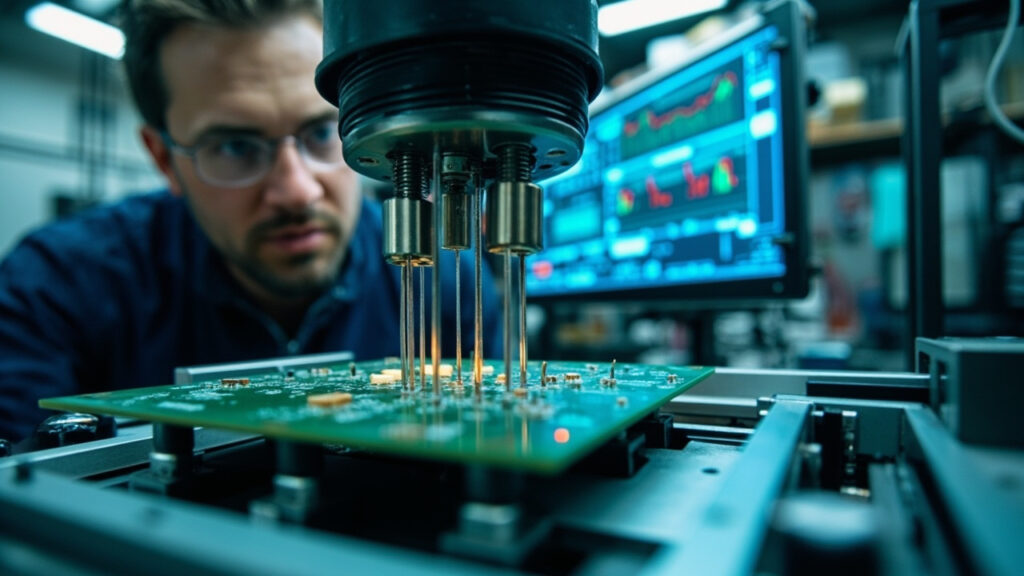
In-circuit testing (ICT) is a powerful diagnostic tool used to verify the integrity of individual components and their connections on a printed circuit board (PCB). This method applies electrical signals to specific points on the board and measures the response, allowing for the detection of a wide range of manufacturing defects. ICT is particularly effective at identifying:
- Shorts and Opens: Incorrect connections or breaks in traces.
- Missing Components: Components that were not placed during assembly.
- Incorrectly Placed Components: Components oriented incorrectly or placed in the wrong location.
- Wrong Components: Components with incorrect values (e.g., wrong resistor value).
- Component Failures: Malfunctioning resistors, capacitors, inductors, diodes, and transistors.
ICT provides rapid and precise fault isolation, often down to the component level. This allows for efficient rework and correction, significantly reducing the time and cost associated with troubleshooting complex assemblies later in the production cycle or, worse, after deployment in the field. For high-volume production, ICT is an indispensable step in ensuring consistent quality and minimizing costly field failures.
Functional Testing (FCT): Verifying Operational Performance
Functional testing (FCT) goes beyond component-level verification to assess the overall operational performance of the electronic assembly. This type of testing simulates the end-use environment of the product, verifying that the PCB or complete box-build functions as intended under specified conditions. FCT typically involves:
- Power-Up and Self-Test Sequences: Verifying basic power delivery and initial system checks.
- Input/Output (I/O) Verification: Testing all input and output ports for correct operation.
- Software/Firmware Loading and Verification: Ensuring correct software installation and functionality.
- Performance Under Load: Simulating operational stresses to confirm stability and reliability.
- Communication Protocols: Testing interfaces like USB, Ethernet, SPI, I2C, etc.
- Environmental Simulation (where applicable): Testing performance across temperature ranges or other environmental factors.
FCT is crucial for confirming that the assembled product meets its design specifications and will perform reliably in its intended application. It provides a final validation of the manufacturing process and the design itself, offering confidence in the product's durability and uptime in the field. For complex systems and mission-critical applications, robust FCT is non-negotiable.
The Four Points Platinum Advantage: Integrated Manufacturing and Testing
Four Points Platinum offers a distinct advantage by providing both mechanical and electronics manufacturing, coupled with comprehensive testing capabilities, all under one roof. This integrated approach delivers several key benefits for our clients:
- Single-Source Accountability: We manage the entire process, from component procurement and assembly to rigorous testing, providing a single point of contact and responsibility. This simplifies project management and reduces communication overhead.
- Coordinated Tolerances and Fit: Our expertise in both CNC machining and precision sheet metal fabrication, alongside PCB assembly, ensures that mechanical and electronic components integrate seamlessly. This holistic view is critical for complex box-builds where fit, form, and function are interdependent.
- Design-for-Manufacturability (DFM) Advisory: Our engineering team provides DFM consultation throughout the design phase, identifying potential manufacturing and testing challenges early on. This proactive approach optimizes designs for efficient production and reliable testing, reducing total cost of ownership.
- Streamlined Production Flow: Integrating testing directly into our manufacturing facility eliminates the need for external logistics and potential delays. This improves lead times and enhances supply chain security, crucial for OEMs requiring production continuity.
- Enhanced Quality Control: With in-house ICT and FCT, we maintain tight control over quality at every stage. Any identified issues can be addressed immediately, preventing defects from propagating further down the production line.
- Reduced Risk and Cost: Early detection of defects through ICT and FCT significantly reduces rework costs, warranty claims, and the risk of product recalls. This translates to a lower total cost of ownership for our clients.
Our capabilities support a wide range of applications, from industrial controls and medical devices to telecommunications equipment and consumer electronics. We work with national brands like Dell, IBM, and 3M, understanding the stringent requirements for high-quality, reliable electronic assemblies.
Choosing a Contract Manufacturer with Integrated Testing Capabilities
When evaluating contract manufacturers, consider the following factors related to their testing capabilities:
- In-House Expertise: Does the manufacturer have dedicated testing engineers and technicians with experience in both ICT and FCT?
- Equipment and Technology: Do they utilize modern ICT fixtures (e.g., bed-of-nails testers) and configurable FCT setups tailored to specific product requirements?
- Custom Test Development: Can they develop custom test procedures and fixtures based on your product's unique specifications and performance criteria?
- Traceability and Reporting: Do they provide comprehensive test reports and maintain traceability of test results for each assembly?
- Integration with Manufacturing: How seamlessly are testing processes integrated into their overall manufacturing workflow?
- Quality Management Systems: Are their testing processes part of a robust quality management system (e.g., ISO 9001 compliant)?
By partnering with a contract manufacturer like Four Points Platinum that offers integrated in-circuit and functional testing, you gain a strategic advantage. You secure a partner committed to delivering not just assembled products, but fully verified, high-performance electronic assemblies that meet your exact specifications and exceed your quality expectations.
Frequently Asked Questions
Why is in-circuit testing (ICT) important for my electronic assemblies?
ICT is crucial because it quickly and accurately identifies manufacturing defects at the component level, such as shorts, opens, missing, or incorrect components. This early detection prevents more complex and costly issues later in the production process or in the field.
How does functional testing (FCT) differ from in-circuit testing?
While ICT verifies individual components and connections, FCT assesses the overall operational performance of the electronic assembly by simulating its real-world use. It ensures the product functions as designed, verifying software, inputs, outputs, and performance under various conditions.
Can Four Points Platinum develop custom test fixtures for my unique product?
Yes, Four Points Platinum's engineering team can design and implement custom test fixtures and procedures tailored to the specific requirements of your product. This ensures comprehensive testing that aligns precisely with your design specifications and performance criteria.
What types of products benefit most from integrated ICT and FCT services?
Products requiring high reliability, complex functionality, or those produced in medium to high volumes benefit significantly. This includes industrial controls, medical devices, telecommunications equipment, and any electronic assembly where field failures are costly or critical.
How does integrated testing improve lead times and supply chain security?
By performing both manufacturing and testing in-house, Four Points Platinum eliminates the need for external transfers and coordination, streamlining the production flow. This reduces overall lead times and enhances supply chain security by keeping critical processes under one roof.
Ready to Ensure the Quality of Your Electronic Assemblies?
Partner with Four Points Platinum for comprehensive electronics manufacturing and integrated testing services. Our expertise in in-circuit and functional testing, combined with our full mechanical manufacturing capabilities, provides a single-source solution for your most demanding projects. Contact us today to discuss your project requirements and discover how our integrated approach can enhance your product's quality, reliability, and time-to-market.