Blog
Integrated Manufacturing: Coordinating Machining, PCB, and Mechanical Assembly
For original equipment manufacturers (OEMs) and hardware companies, managing complex product builds often involves coordinating multiple vendors for different manufacturing processes. This fragmented approach can introduce significant challenges, including communication breakdowns, scheduling conflicts, quality control issues, and increased lead times. The solution lies in partnering with an integrated contract manufacturer capable of coordinating all critical stages—from precision CNC machining and sheet metal fabrication to advanced PCB assembly, mechanical assembly, and comprehensive testing—under a single roof.
This guide explores the advantages of a unified manufacturing approach and how a single-source partner can streamline your production, enhance product quality, and ensure supply chain security for projects requiring diverse manufacturing disciplines.
The Challenges of Disjointed Manufacturing Processes
When a product requires both intricate mechanical components and sophisticated electronic assemblies, managing separate suppliers for each can quickly become a logistical nightmare. Consider the common pitfalls:
- Communication Overhead: Juggling multiple points of contact, specifications, and revision controls across different vendors consumes valuable engineering and project management resources.
- Tolerance Stacking and Fit Issues: Mechanical and electronic components must integrate seamlessly. Without a unified approach, slight deviations from one vendor can lead to significant fitment problems during final assembly, requiring costly rework or redesigns.
- Quality Control Discrepancies: Each vendor operates under its own quality protocols. Ensuring consistent quality across all components and assemblies becomes a complex audit task, increasing the risk of defects in the final product.
- Extended Lead Times and Scheduling Delays: Dependencies between different manufacturing stages mean that a delay at one vendor can cascade through the entire production schedule, impacting time-to-market.
- Increased Logistics and Inventory Management: Shipping components between multiple facilities adds to transportation costs, increases the risk of damage, and complicates inventory tracking.
- Lack of Single-Point Accountability: When issues arise, determining responsibility among multiple vendors can be challenging, leading to finger-pointing and delayed resolutions.
The Integrated Manufacturing Advantage: A Single-Source Solution
An integrated contract manufacturer eliminates these challenges by providing a comprehensive suite of services under one management system. This approach offers significant benefits for OEMs and hardware companies seeking efficiency, quality, and reliability.
Seamless Coordination of Diverse Processes
A true integrated manufacturer possesses the in-house capabilities and expertise to manage:
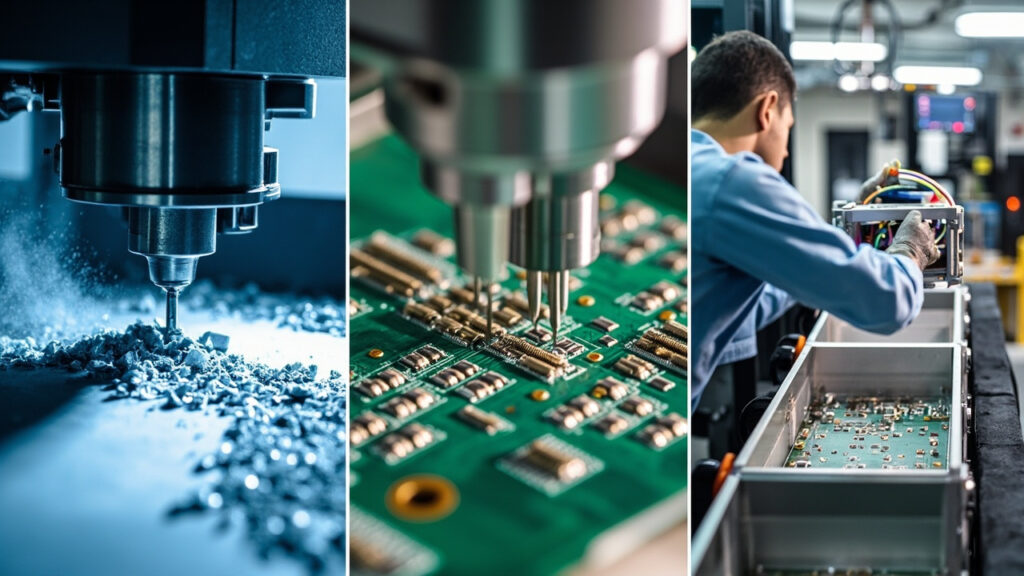
- Precision CNC Machining and Multi-Axis Milling: Producing complex mechanical parts with tight tolerances from various materials.
- Precision Sheet Metal Fabrication: Creating enclosures, brackets, and structural components.
- PCB Assembly (PCBA) and Surface Mount Technology (SMT): Populating printed circuit boards with electronic components, including fine-pitch and BGA devices.
- Through-Hole Assembly: For components requiring robust mechanical connections.
- Mechanical Assembly and Box Builds: Integrating all mechanical and electronic sub-assemblies into a complete, functional product.
- Testing and Quality Assurance: Comprehensive functional testing, in-circuit testing (ICT), and environmental testing to ensure product performance and reliability.
By centralizing these operations, the manufacturer can coordinate schedules, material flow, and quality checks with unparalleled precision.
Enhanced Design-for-Manufacturability (DFM) and Design-for-Assembly (DFA)
With both mechanical and electronics engineering expertise under one roof, an integrated partner can provide invaluable DFM and DFA insights from the earliest stages of product development. This collaborative approach ensures that:
- Component Compatibility: Mechanical designs are optimized for electronic integration, and vice-versa, preventing costly redesigns later in the process.
- Tolerance Stacking Analysis: Engineers can proactively identify and mitigate potential fitment issues between machined parts, sheet metal enclosures, and PCBs.
- Assembly Efficiency: Products are designed for efficient assembly, reducing labor costs and potential for errors.
- Material Selection Optimization: Recommendations for materials that meet both mechanical strength and electrical performance requirements.
Streamlined Supply Chain and Inventory Management
An integrated partner simplifies your supply chain by acting as a single point of contact for all components and sub-assemblies. This includes:
- Consolidated Procurement: Leveraging purchasing power for better material costs and lead times.
- Blanket Order Programs: Providing inventory solutions to ensure production continuity and mitigate supply chain disruptions.
- Reduced Logistics: Eliminating the need to ship components between multiple vendors, lowering costs and transit times.
- Single-Point Accountability: A clear line of responsibility for the entire manufacturing process, from raw materials to final product.
Consistent Quality and Reduced Risk
Unified quality management systems across all manufacturing stages lead to superior product quality. This includes:
- Coordinated Quality Checks: Implementing consistent inspection protocols for both mechanical and electronic components.
- Traceability: Full traceability of components and processes throughout the entire build.
- Reduced Rework: Proactive identification and resolution of issues before they escalate, minimizing costly rework and scrap.
- Reliable Performance: Products that consistently meet specifications and perform reliably in the field, enhancing brand reputation.
Key Considerations When Choosing an Integrated Manufacturer
To ensure a successful partnership, evaluate potential manufacturers based on these critical factors:
- Breadth of Capabilities: Verify that they possess the specific CNC machining, sheet metal fabrication, PCB assembly (SMT, through-hole), and box-build capabilities required for your product.
- Engineering Expertise: Look for a team that can offer DFM/DFA consultation, not just execute designs. Their ability to identify and solve potential manufacturing challenges upfront is invaluable.
- Quality Management System: Inquire about their quality control processes, certifications (if applicable), and how they ensure consistency across diverse manufacturing disciplines.
- Project Management: Assess their project management methodology for coordinating complex builds involving multiple stages.
- Customer References and Track Record: Evaluate their experience with similar projects and their ability to serve demanding clients, including national brands.
- Scalability: Ensure they can support your production needs from rapid prototyping to full-scale production volumes.
- Supply Chain Resilience: Discuss their strategies for managing material procurement, mitigating supply chain risks, and offering inventory programs.
Four Points Platinum: Your Partner for Integrated Manufacturing
Four Points Platinum offers a comprehensive, integrated solution for OEMs and hardware companies requiring precision mechanical and electronics manufacturing. Based in the Austin metro area, we provide a single source for:
- Advanced CNC Machining: Multi-axis milling for complex geometries and tight tolerances.
- Precision Sheet Metal Fabrication: Custom enclosures, brackets, and structural components.
- State-of-the-Art PCB Assembly: SMT component population, through-hole assembly, and advanced soldering techniques.
- Full Mechanical Assembly and Box Builds: Expert integration of all components into finished products.
- Design-for-Manufacturability Advisory: Collaborative engineering to optimize designs for efficient and cost-effective production.
- Blanket Order Inventory Programs: Ensuring production continuity and supply chain security.
Our end-to-end support, coordinated tolerances, and single-point accountability simplify complex projects, allowing you to focus on innovation and market growth. We serve a diverse range of industries, delivering high-quality, integrated solutions for critical applications.
Frequently Asked Questions
What does it mean to have integrated mechanical and electronics manufacturing under one roof?
It means that a single contract manufacturer handles both the creation of physical parts (like CNC machined components or sheet metal enclosures) and the assembly of electronic circuit boards (PCBs), along with the final integration of these elements into a complete product. This eliminates the need to coordinate between separate vendors for different manufacturing stages.
How does integrated manufacturing improve product quality and reliability?
By having all processes managed by one entity, there's consistent quality control across both mechanical and electronic components. This ensures better fit and function, reduces tolerance stacking issues, and allows for comprehensive testing of the entire assembly, leading to a more reliable final product.
Can an integrated manufacturer help with design optimization?
Yes, a key benefit is their ability to provide Design-for-Manufacturability (DFM) and Design-for-Assembly (DFA) feedback. With expertise in both mechanical and electronics, they can identify potential issues early in the design phase, optimizing your product for efficient production and improved performance.
What types of testing are typically included in integrated manufacturing projects?
Integrated manufacturers often provide a range of testing services, including in-circuit testing (ICT) for PCBs, functional testing of sub-assemblies, full system functional testing, and sometimes environmental testing. This ensures that both individual components and the final product meet all specified performance criteria.
How does this approach impact lead times and project timelines?
Consolidating manufacturing processes under one roof significantly reduces lead times. It eliminates transit times between different vendors, streamlines communication, and allows for more efficient scheduling and coordination of interdependent manufacturing steps, accelerating your time to market.
Is integrated manufacturing suitable for both prototyping and high-volume production?
Yes, an effective integrated manufacturer can support projects from rapid prototyping and small-batch runs to full-scale, high-volume production. Their ability to scale operations while maintaining consistent quality is a critical advantage for OEMs and hardware companies.
Next Steps: Partnering for Production Continuity
Navigating the complexities of modern product manufacturing requires a partner with diverse capabilities and a commitment to quality. By choosing an integrated contract manufacturer, you gain a strategic advantage, ensuring your products are built efficiently, reliably, and to the highest standards. Contact us today to discuss your project requirements and discover how our integrated manufacturing solutions can support your success.