Blog
Integrated Fabrication and Machining for Custom Mechanical Components
Integrated mechanical and electronics contract manufacturers provide a single source for producing custom brackets, frames, panels, and other fabricated components. This approach streamlines the manufacturing process by combining precision machining, sheet metal fabrication, and electronics assembly under one roof.
Companies like Four Points Platinum, based in Pflugerville, Texas, offer comprehensive services from rapid prototyping to full-scale production for OEMs and hardware companies.
Key Takeaways
- Integrated mechanical and electronics contract manufacturers streamline the production of custom components by offering all services from a single source.
- Combining CNC machining, sheet metal fabrication, and PCB assembly ensures coordinated tolerances and fit for complete assemblies.
- A single supplier reduces hand-offs, mitigates supply chain risks, and provides unified accountability for complex projects.
- Design-for-manufacturability (DFM) consultation helps optimize designs for efficient production, minimizing costs and accelerating time to market.
- Blanket order programs and inventory readiness support production continuity and supply chain security for OEMs.
The complexity of modern hardware demands a manufacturing approach that can handle both mechanical and electronic components with precision and efficiency. OEMs and hardware companies often face challenges coordinating multiple suppliers for different parts of a single assembly, leading to potential delays, compatibility issues, and increased costs. An integrated contract manufacturer addresses these challenges by offering a unified solution.
What is Integrated Mechanical and Electronics Contract Manufacturing?
Integrated mechanical and electronics contract manufacturing involves a single supplier providing both the mechanical components and the electronic assemblies required for a complete product. This encompasses services such as CNC machining, precision sheet metal fabrication, PCB assembly, and full box-build assembly. The goal is to provide a cohesive production process from initial design to final product, ensuring all components fit and function together as intended.
This model contrasts sharply with the traditional approach of using separate machine shops for mechanical parts and electronics manufacturing services (EMS) providers for PCBs. By consolidating these functions, integrated manufacturers offer a single point of contact, unified quality control, and coordinated project management. This can be particularly beneficial for complex products requiring tight tolerances between mechanical and electronic elements, such as those found in industrial equipment, medical devices, or aerospace applications NIST.
Why Should OEMs Consider an Integrated Manufacturer for Custom Components?
Choosing an integrated manufacturer for custom mechanical components like brackets, frames, and panels offers significant advantages, especially when these components house or interact with electronic assemblies. The primary benefit is the elimination of hand-offs between multiple vendors, which often introduces delays, communication errors, and accountability gaps. A single supplier manages the entire process, from raw material procurement to final assembly and testing.
This integrated approach ensures that mechanical parts are designed and manufactured with the electronic components in mind, and vice versa. For example, the mounting points on a custom frame can be precisely machined to accommodate a specific PCB, preventing fitment issues that might arise when parts come from different sources. This holistic view of the product lifecycle supports better design for manufacturability (DFM) and overall product quality.
How does a single supplier improve project timelines and reduce supply chain risk?
A single supplier significantly improves project timelines by reducing the administrative overhead and lead times associated with managing multiple vendors. Instead of coordinating schedules, quotes, and deliveries from several companies, OEMs interact with one partner. This consolidation simplifies communication channels and accelerates decision-making, allowing projects to move through development and production phases more quickly.
Furthermore, a single supplier mitigates supply chain risks by centralizing accountability. If an issue arises with a complete assembly, there is no ambiguity about which vendor is responsible. This clear line of responsibility helps in quickly identifying and resolving problems, minimizing disruptions to production. For hardware companies requiring production continuity and supply-chain security, this unified approach is invaluable.
What Manufacturing Capabilities Are Essential for Precision Components?
An integrated manufacturer specializing in precision mechanical and electronic components should offer a comprehensive suite of capabilities to meet diverse OEM needs. These capabilities ensure that custom brackets, frames, and panels are produced to exact specifications and integrate effectively with electronic assemblies. The range of services should cover both the mechanical and electronic aspects of manufacturing.
For mechanical components, core capabilities include advanced CNC machining, precision sheet metal fabrication, and various assembly processes. On the electronics side, expertise in PCB assembly, surface mount technology (SMT), and through-hole assembly is crucial. The ability to perform full box-build assembly, where all mechanical and electronic components are integrated into a finished product, is also a key differentiator.
What role does CNC machining and multi-axis milling play in component accuracy?
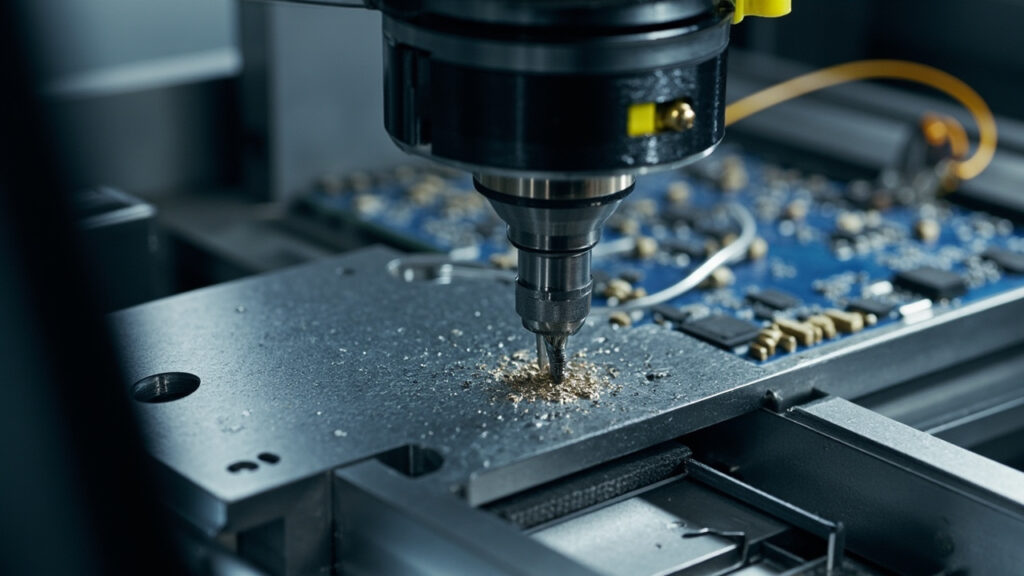
CNC machining is fundamental for producing custom brackets, frames, and panels with high precision and repeatability. Multi-axis milling capabilities, such as 3-axis, 4-axis, or 5-axis machining, allow for the creation of complex geometries and intricate features that would be difficult or impossible with traditional methods. This is essential for components requiring tight tolerances and specific surface finishes.
The precision of CNC machining ensures that mounting holes, cutouts, and other features align perfectly with mating components, including electronic circuit boards. This capability is critical for applications where exact fit and function are paramount, such as enclosures for sensitive electronics or structural components in high-performance systems.
How does precision sheet metal fabrication support integrated assemblies?
Precision sheet metal fabrication involves cutting, bending, and forming metal sheets into custom shapes. This process is ideal for creating enclosures, chassis, panels, and structural components that are lightweight yet robust. Modern sheet metal fabrication utilizes advanced equipment like laser cutters, press brakes, and turret punches to achieve high accuracy and efficiency.
When integrated with electronics manufacturing, sheet metal fabrication can produce custom enclosures that precisely fit PCBs and other electronic modules. This ensures proper shielding, thermal management, and protection for the internal electronics. The ability to control the entire process from flat sheet to finished assembly minimizes design compromises and accelerates time to market.
Why is integrated PCB assembly and SMT component population important?
PCB assembly is the process of populating bare circuit boards with electronic components. Surface Mount Technology (SMT) is the dominant method for placing components directly onto the surface of PCBs, enabling high-density designs and miniaturization. Through-hole assembly is also offered for components that require greater mechanical strength or specific electrical properties.
An integrated manufacturer performs PCB assembly in conjunction with mechanical fabrication, ensuring that the electronic boards are designed to fit perfectly within their custom mechanical housings. This coordinated approach prevents common issues like misaligned mounting holes or insufficient clearance, which can arise when mechanical and electronic designs are developed in isolation.
What are the advantages of full box-build assembly and subassemblies?
Full box-build assembly involves integrating all mechanical and electronic components, wiring, and subassemblies into a complete, functional product. This service includes everything from installing PCBs into custom enclosures to final testing and packaging. For OEMs, this means receiving a finished product ready for distribution or further integration into a larger system.
The ability to manage subassemblies, such as pre-wired panels or integrated sensor modules, further enhances efficiency. This reduces the number of parts an OEM needs to manage and assemble internally, freeing up their resources to focus on core competencies. Four Points Platinum offers complete assembly services, providing single-point accountability for finished products.
How Do DFM and Blanket Order Programs Add Value for OEMs?
Beyond core manufacturing capabilities, an integrated contract manufacturer adds significant value through services like Design-for-Manufacturability (DFM) consultation and flexible inventory programs. These services are crucial for optimizing product designs for efficient production and ensuring a stable supply chain.
DFM involves reviewing product designs to identify potential manufacturing challenges and suggest modifications that can reduce costs, improve quality, and accelerate production. For custom brackets, frames, and panels, DFM feedback might include recommendations on material selection, part consolidation, or feature simplification to optimize machining or fabrication processes. This proactive approach helps avoid costly redesigns later in the production cycle.
Blanket order programs and inventory readiness services provide OEMs with production continuity and supply-chain security. Under a blanket order, an OEM commits to purchasing a certain quantity of parts over a period, allowing the manufacturer to produce and hold inventory. This ensures that parts are readily available when needed, reducing lead times and mitigating risks associated with material shortages or unexpected demand spikes. This is especially valuable for high-mix, low-to-medium volume production scenarios [Four Points Platinum: High-Mix, Low-to-Medium Volume Production for OEMs](/insights/blog/high-mix-low-to-medium-volume-production-for-oems).
Integrated Manufacturing vs. Separate Suppliers: Which is Better for Your Project?
The decision between an integrated manufacturer and separate suppliers for mechanical and electronic components involves trade-offs in terms of cost, lead time, quality control, and accountability. Understanding these differences is crucial for procurement and engineering teams.
| Feature | Integrated Manufacturer | Separate Machine Shop + EMS Provider |
|---|---|---|
| Quotes & Billing | One consolidated quote and invoice for the complete assembly | Multiple quotes and invoices from different vendors |
| Project Management | Single point of contact, unified project management | Multiple points of contact, requires internal coordination |
| Design Coordination | Coordinated tolerances and fit between mechanical and electronics | Requires significant internal effort to ensure compatibility |
| Lead Time | Often reduced due to fewer hand-offs and streamlined processes | Can be extended due to scheduling and communication between vendors |
| Accountability | Single source of accountability for the entire assembly | Shared accountability, potential for blame shifting |
| Quality Control | Unified quality standards and inspection processes | Varied quality standards and inspection protocols across vendors |
| DFM Feedback | Holistic DFM feedback considering both mechanical and electronic aspects | DFM feedback often siloed to specific component types |
| Supply Chain Risk | Centralized risk management, simplified supplier relationships | Increased complexity, higher risk of disruptions from a single vendor |
This comparison highlights how an integrated approach simplifies the manufacturing process and reduces potential points of failure. For complex hardware products, the benefits of unified accountability and coordinated design often outweigh any perceived cost savings from sourcing components separately.
What Information Should You Include in an RFQ for a Complete Assembly?
When requesting a quote for a complete assembly that includes custom brackets, frames, panels, and electronic components, providing comprehensive information is critical for accurate pricing and efficient production. A detailed Request for Quote (RFQ) helps the manufacturer understand the project scope and requirements fully.
Key elements to include in an RFQ for a complete assembly:
- Detailed CAD Models and Drawings: Provide 2D and 3D CAD files for all mechanical components (brackets, frames, panels) and the complete assembly. Include critical dimensions, tolerances, material specifications, and surface finish requirements.
- Bill of Materials (BOM): A comprehensive list of all components, including part numbers, quantities, manufacturers, and approved vendors. Specify any long-lead-time or custom-ordered parts.
- PCB Design Files: Include Gerber files, drill files, assembly drawings, and netlists for all printed circuit boards. Specify any special fabrication requirements or material types.
- Assembly Instructions: Provide step-by-step instructions for assembling the complete product, including any specific torque requirements, wiring diagrams, or testing procedures.
- Testing Requirements: Detail any functional testing, in-circuit testing (ICT), or environmental testing that needs to be performed on the finished assembly.
- Quality Standards and Certifications: Specify any required quality standards (e.g., ISO 9001, IPC-A-610) or industry-specific certifications.
- Volume and Delivery Schedule: Indicate the required production volumes (prototype, low-volume, high-volume) and desired delivery timelines.
- Packaging and Shipping Instructions: Specify any particular packaging requirements or shipping preferences.
Providing this level of detail upfront minimizes questions and ensures that the manufacturer can provide an accurate and competitive quote. It also sets the foundation for a smooth production process from the outset.
How Does an Integrated Manufacturer Ensure Quality from Prototype to Production?
Moving from a prototype to repeatable production requires careful planning and robust processes to maintain quality and consistency. An integrated manufacturer with documented workflows for quoting, scheduling, inspection, and change control is essential for this transition. This structured approach ensures that every unit produced meets the specified requirements.
Rapid prototyping services allow OEMs to quickly test and validate designs before committing to full-scale production. Once a design is finalized, the manufacturer implements a controlled production process. This includes rigorous in-process inspection, final quality checks, and adherence to established standards. The ability to manage both prototyping and production under one roof simplifies the transition and ensures design intent is maintained throughout.
Four Points Platinum supports end-to-end product development from rapid prototyping to full-scale production [Four Points Platinum: Product Development: Prototype to Production with a Single Partner](/insights/blog/seamless-product-development-prototype-to-production-with-a-single-partner).
For example, the International Organization for Standardization (ISO) provides standards like ISO 9001 for quality management systems, which help ensure consistent product quality and customer satisfaction ISO. Similarly, the IPC (Association Connecting Electronics Industries) develops standards for the design and manufacture of electronic assemblies, such as IPC-A-610, which outlines criteria for acceptable electronic assemblies IPC. Adherence to such standards is a strong indicator of a manufacturer's commitment to quality.
Frequently Asked Questions
What are the benefits of using a single supplier for both mechanical and electronic manufacturing?
Using a single supplier for both mechanical and electronic manufacturing streamlines the entire production process. It reduces hand-offs, minimizes communication errors, and provides a single point of accountability for the complete assembly. This approach often leads to faster lead times, improved design coordination, and higher overall product quality.
How does an integrated manufacturer handle design changes during production?
An integrated manufacturer typically has documented workflows for change control. This means any design changes are formally reviewed, approved, and implemented across both mechanical and electronic production lines in a coordinated manner. This systematic approach ensures that all components remain compatible and that quality is maintained throughout the revision process.
Can integrated manufacturers support both low-volume and high-volume production?
Many integrated manufacturers are equipped to support a range of production volumes, from rapid prototyping and low-volume runs to medium and even high-volume production. Their flexibility often stems from adaptable manufacturing processes and the ability to scale resources as needed. It's important to discuss specific volume requirements with the manufacturer.
What kind of precision can I expect for custom fabricated components?
The precision achievable for custom fabricated components depends on the manufacturer's equipment and expertise. Advanced CNC machining and precision sheet metal fabrication can achieve very tight tolerances, often measured in thousandths of an inch or micrometers. Always inquire about specific machine capabilities and achievable tolerances when selecting a manufacturing partner.
How do integrated manufacturers ensure the quality of both mechanical and electronic parts?
Integrated manufacturers ensure quality through comprehensive quality management systems, often adhering to industry standards like ISO 9001 and IPC-A-610. They implement rigorous inspection processes at various stages of production, from raw material inspection to in-process checks and final assembly testing. This holistic approach guarantees the quality of both mechanical and electronic components.
Next Step
To discuss your specific project requirements for integrated mechanical and electronics manufacturing, contact Four Points Platinum to request a quote for your custom brackets, frames, panels, and complete assemblies.