
Blog
Custom Machined Parts Texas: Manufacturing Pneumatic Manifolds for Automation
Manufacturing pneumatic manifolds and other fluid-power components for automation systems requires precision machining and often integrated electronics. Companies in Texas, like Four Points Platinum, offer integrated mechanical and electronics contract manufacturing to produce these complex assemblies. This approach ensures coordinated tolerances and single-source accountability for complete systems.
Key Takeaways
- Integrated manufacturers in Texas provide a single source for both mechanical and electronic components of pneumatic manifolds.
- Precision CNC machining and multi-axis milling are critical for producing the intricate channels and ports required in fluid power components.
- Design-for-manufacturability (DFM) consultation helps optimize pneumatic manifold designs for efficient production and performance.
- Consolidating mechanical and electronics manufacturing under one roof streamlines supply chains and reduces lead times for automation system components.
- Blanket order programs and inventory readiness ensure production continuity and supply-chain security for OEMs needing custom parts.
Pneumatic manifolds are central to automation systems, directing and controlling air flow to various actuators and components. Their effectiveness hinges on precise machining, material selection, and often, the integration of electronic controls. OEMs and hardware companies frequently seek specialized contract manufacturers capable of delivering these complex parts with high reliability and efficiency.
What are Pneumatic Manifolds and Why are They Critical in Automation?
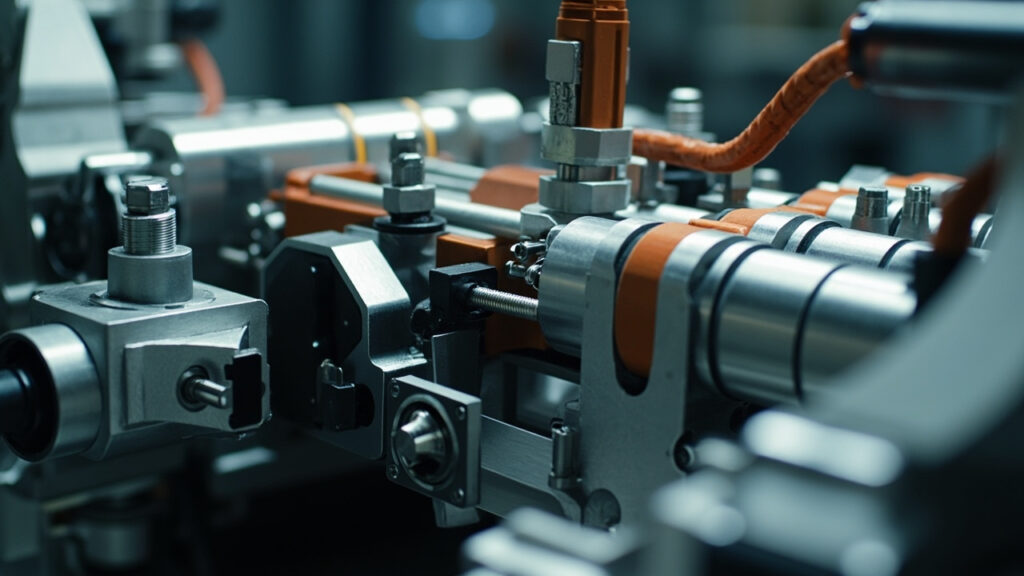
Pneumatic manifolds are blocks of material, typically aluminum or stainless steel, that distribute compressed air from a single input source to multiple output ports. They consolidate numerous pneumatic valves, fittings, and tubing into a compact unit, simplifying system design, reducing potential leak points, and improving overall system response time. In automation, they are critical for controlling robotic arms, clamping mechanisms, and other actuated components.
The internal channels and passages within a manifold must be machined with high accuracy to ensure consistent air flow, minimize pressure drops, and prevent cross-contamination between circuits. Precision is paramount, as even minor deviations can impact system performance and reliability. NIST emphasizes the importance of precision manufacturing in advanced automation.
How Does Integrated Manufacturing Benefit Pneumatic Manifold Production?
Integrated mechanical and electronics manufacturing offers significant advantages for producing pneumatic manifolds, especially those that incorporate electronic control elements. Instead of managing separate suppliers for the machined block and the PCB assembly, OEMs can work with a single partner. Four Points Platinum, based in Pflugerville, Texas, provides this integrated approach, handling both CNC machining and PCB assembly under one roof.
This single-source model streamlines the entire production process, from rapid prototyping to full-scale production. It allows for coordinated tolerances and fit between mechanical and electronic components, reducing potential interface issues and assembly challenges. A unified approach also simplifies quoting, scheduling, and change control, leading to greater efficiency and accountability.
| Feature | Integrated Manufacturer | Separate Machine Shop & EMS |
|---|---|---|
| Accountability | Single point of contact | Multiple points of contact |
| Design Coordination | Coordinated mechanical & electronic DFM | Separate DFM reviews, potential conflicts |
| Lead Time | Reduced hand-offs, faster overall | Increased hand-offs, longer overall |
| Quality Control | Unified inspection processes | Disjointed inspection, potential gaps |
| Cost Management | Consolidated quoting, potential savings | Multiple quotes, higher administrative burden |
| Risk Management | Centralized supply chain | Dispersed supply chain risks |
What Machining Processes are Essential for Fluid Power Components?
Manufacturing high-performance fluid power components like pneumatic manifolds relies heavily on advanced machining processes. CNC machining, including multi-axis milling, is fundamental for creating the intricate internal geometries, precise port locations, and smooth surface finishes required. These processes ensure the tight tolerances necessary for effective sealing and consistent fluid flow.
- CNC Machining: Computer Numerical Control (CNC) machining uses pre-programmed computer software to control the movement of machine tools. This allows for highly accurate and repeatable production of complex shapes.
- Multi-Axis Milling: 3-axis, 4-axis, and 5-axis milling machines provide greater flexibility to machine complex geometries from multiple angles without re-fixturing the workpiece. This is crucial for creating the internal channels and angled ports common in manifolds.
- Precision Drilling and Tapping: Accurate drilling for port connections and tapping for threaded interfaces are critical for secure and leak-free assembly of valves and fittings.
- Surface Finishing: Achieving specific surface finishes within the manifold's channels can reduce friction and improve flow characteristics, which is vital for pneumatic system efficiency.
Four Points Platinum utilizes these precision machining capabilities to produce custom mechanical components. The ability to control these processes in-house ensures the quality and consistency of the manifold block before any electronic components are integrated.
How Does Design-for-Manufacturability (DFM) Impact Pneumatic Manifold Production?
Design-for-Manufacturability (DFM) is a critical advisory service that optimizes a product's design for efficient and cost-effective manufacturing. For pneumatic manifolds, DFM consultation can identify potential machining challenges, suggest material alternatives, and recommend design modifications to improve performance and reduce production costs. This proactive approach is particularly valuable when moving from prototype to repeatable production.
An integrated manufacturer can provide DFM feedback that considers both the mechanical and electronic aspects of the manifold. This might involve optimizing channel layouts for easier machining, selecting appropriate materials for specific pressure requirements, or designing PCB footprints that integrate with the manifold's housing. Such collaboration ensures that the final product is not only functional but also manufacturable at scale. For more on this, see Four Points Platinum's insights on [Product Development: Prototype to Production with a Single Partner](/insights/blog/seamless-product-development-prototype-to-production-with-a-single-partner).
What Materials are Commonly Used for Pneumatic Manifolds?
The choice of material for pneumatic manifolds is dictated by factors such as operating pressure, temperature, chemical compatibility, and cost. Each material offers a unique balance of properties suitable for different applications within automation systems.
- Aluminum: Aluminum alloys (e.g., 6061-T6) are widely used due to their excellent machinability, lightweight nature, and good corrosion resistance. They are suitable for most general-purpose pneumatic applications where high pressures are not extreme.
- Stainless Steel: Stainless steel (e.g., 303, 304, 316) offers superior corrosion resistance, higher strength, and better temperature resistance compared to aluminum. It is preferred for applications involving aggressive media, high pressures, or sterile environments, such as in medical or food processing automation.
- Brass: Brass is often chosen for its good machinability, corrosion resistance, and excellent sealing properties. It is commonly used for fittings and smaller manifold blocks where specific thermal or electrical conductivity might be beneficial.
- Engineering Plastics: Certain high-performance engineering plastics, like PEEK or Delrin, can be used for specialized manifolds where weight reduction, electrical insulation, or chemical inertness are primary concerns. However, their pressure ratings are typically lower than metals.
The selection process involves a careful evaluation of the application's specific requirements against the material's properties. SME provides extensive resources on material selection for manufacturing processes.
How Do Blanket Orders and Inventory Programs Ensure Production Continuity?
For OEMs and hardware companies that require a steady supply of custom machined parts and assemblies, blanket order programs and inventory readiness are crucial for production continuity and supply-chain security. A blanket order allows a buyer to place a single order for multiple deliveries over a period, often at a pre-negotiated price. This commitment helps the manufacturer plan production and secure raw materials.
An integrated manufacturer offering these programs can maintain a buffer stock of finished or semi-finished components, ready for immediate shipment as needed. This minimizes lead times for the OEM, reduces the risk of production stoppages due to component shortages, and helps manage inventory costs. Four Points Platinum offers blanket order inventory programs, providing clients with consistent supply and peace of mind. This approach is particularly beneficial for [High-Mix, Low-to-Medium Volume Production for OEMs](/insights/blog/high-mix-low-to-medium-volume-production-for-oems) where demand can fluctuate.
What to Include in an RFQ for a Complete Pneumatic Manifold Assembly?
When requesting a quote for a complete pneumatic manifold assembly, providing comprehensive information is essential for accurate pricing and efficient production. A detailed Request for Quote (RFQ) helps the manufacturer understand the scope of work and provide a precise proposal.
Here's a checklist of key information to include:
- 3D CAD Models and 2D Drawings: Provide detailed models (e.g., STEP, SolidWorks) and drawings (PDF) with dimensions, tolerances (e.g., per ISO standards), surface finish requirements, and critical features.
- Bill of Materials (BOM): List all components, including the manifold block, valves, sensors, fittings, and any integrated electronic components (PCBs, connectors, wiring). Specify part numbers, manufacturers, and quantities.
- Material Specifications: Clearly state the desired material for the manifold block (e.g., 6061-T6 Aluminum, 316 Stainless Steel) and any specific material certifications required.
- Quantity and Delivery Schedule: Specify the required production volumes (e.g., prototype, low-volume, high-volume) and the desired delivery timeline, including any blanket order or inventory program needs.
- Assembly Instructions: Provide clear instructions for the final assembly, including torque specifications, wiring diagrams, and testing procedures.
- Testing and Inspection Requirements: Detail any specific functional testing, pressure testing, leak testing, or inspection criteria (e.g., CMM inspection, visual inspection standards).
- Surface Treatment/Finishing: Specify any required anodizing, plating, passivation, or other surface treatments for the manifold block.
- Packaging and Shipping Requirements: Outline any special packaging, labeling, or shipping instructions.
Providing this level of detail upfront minimizes back-and-forth communication and ensures that the quote accurately reflects the project's complexity and requirements.
Frequently Asked Questions
What is the typical lead time for custom machined pneumatic manifolds?
Lead times for custom machined pneumatic manifolds vary significantly based on design complexity, material availability, and production volume. Prototyping can take a few weeks, while larger production runs may require several months, especially with integrated electronics. Engaging with a manufacturer early in the design phase can help optimize schedules.
Can a single manufacturer handle both the mechanical and electronic aspects of a manifold?
Yes, integrated contract manufacturers like Four Points Platinum specialize in handling both mechanical manufacturing (CNC machining, fabrication) and electronics manufacturing (PCB assembly, SMT) under one roof. This approach simplifies the supply chain, improves coordination, and ensures single-point accountability for the complete assembly.
What are the advantages of using aluminum versus stainless steel for pneumatic manifolds?
Aluminum is lighter, more cost-effective, and easier to machine, making it suitable for general-purpose applications. Stainless steel offers superior corrosion resistance, higher strength, and better performance in high-pressure or harsh environments, but it is more expensive and challenging to machine. The choice depends on specific application requirements.
How important is design-for-manufacturability for custom fluid power components?
Design-for-manufacturability (DFM) is crucial for custom fluid power components. It helps identify and resolve potential manufacturing issues early in the design phase, reducing costs, improving production efficiency, and ensuring the final product meets performance specifications. DFM feedback from an experienced manufacturer is invaluable.
What quality standards apply to pneumatic manifold manufacturing?
Quality standards for pneumatic manifold manufacturing often include general quality management systems like ISO 9001. For electronics integration, IPC standards (e.g., IPC-A-610 for electronic assemblies) are relevant. Specific industry standards may also apply depending on the end application, such as those from IEC for electrical and electronic technologies.
For OEMs and hardware companies requiring custom machined parts in Texas, particularly complex assemblies like pneumatic manifolds, Four Points Platinum offers integrated mechanical and electronics contract manufacturing services. Contact us today to discuss your project requirements and how our capabilities can support your automation system needs.