Blog
Integrated Manufacturing for Complex Electromechanical Products
For original equipment manufacturers (OEMs) and hardware companies developing sophisticated products, the challenge of coordinating multiple vendors for mechanical and electronic components can introduce significant risks. Disjointed supply chains lead to increased lead times, potential for tolerance mismatches, and diffused accountability. A genuinely integrated approach to manufacturing complex electromechanical products offers a strategic advantage, consolidating these critical processes under a single roof.
This guide explores the benefits and operational considerations of integrated manufacturing, detailing how a unified provider can streamline your production, enhance product quality, and secure your supply chain for high-mix, complex assemblies.
What Defines a Genuinely Integrated Manufacturing Approach?
A genuinely integrated manufacturing approach goes beyond simply offering both mechanical and electronics services. It signifies a cohesive operational model where these disciplines are not just co-located but deeply intertwined from design to final assembly. This integration ensures seamless coordination, shared quality control protocols, and a unified understanding of the end product's functional requirements and performance specifications.
Key characteristics include:
- Unified Engineering & Design Review: Mechanical and electrical engineers collaborate from the outset, identifying potential design-for-manufacturability (DFM) issues across both domains. This proactive approach minimizes costly redesigns and ensures optimal fit and function.
- Coordinated Production Planning: Schedules for CNC machining, sheet metal fabrication, PCB assembly, and final box-build are synchronized, eliminating bottlenecks and reducing overall lead times. Material flow is optimized across all stages.
- Single-Point Accountability: One manufacturing partner assumes full responsibility for the entire product, from individual components to the complete, tested assembly. This simplifies communication, problem-solving, and quality assurance.
- Integrated Quality Control: Quality checks are applied consistently across all manufacturing stages, ensuring that mechanical tolerances align with electronic component placement and overall system performance. This prevents issues that might arise from separate quality systems.
- Optimized Supply Chain Management: A single partner manages the procurement of all raw materials and components, leveraging economies of scale and mitigating supply chain risks more effectively than managing multiple vendors.
The Operational Advantages of Integrated Electromechanical Manufacturing
Choosing a manufacturer that provides genuinely integrated services offers substantial operational benefits for OEMs focused on complex electromechanical products.
Streamlined Production and Reduced Lead Times
Consolidating mechanical and electronics manufacturing under one roof eliminates the need to ship sub-assemblies between different vendors. This directly translates to:
- Faster Turnaround: Reduced transit times and synchronized production schedules accelerate the entire manufacturing cycle.
- Minimized Delays: The risk of delays due to miscommunication or scheduling conflicts between separate suppliers is virtually eliminated.
- Optimized Resource Allocation: Internal resources are freed from managing multiple vendor relationships, allowing them to focus on core competencies.
Enhanced Product Quality and Reliability
Integrated manufacturing inherently leads to higher quality outcomes due to:
- Precise Tolerance Coordination: Critical mechanical tolerances are directly correlated with PCB mounting points and component clearances, ensuring perfect fit and function from the outset. This is crucial for applications requiring high precision.
- Consistent Quality Standards: A single quality management system oversees all processes, from raw material inspection to final product testing, ensuring uniform adherence to specifications.
- Improved Design for Manufacturability (DFM): Early collaboration between mechanical and electrical teams identifies and resolves potential manufacturing challenges before they impact production, leading to more robust and reliable designs.
Greater Supply Chain Security and Resilience
In today's volatile global market, supply chain resilience is paramount. An integrated manufacturer provides:
- Reduced Vendor Management Complexity: Fewer suppliers mean fewer points of failure and simplified oversight.
- Consolidated Procurement: Leveraging a single partner's purchasing power and established supplier relationships can lead to better material availability and pricing.
- Proactive Risk Mitigation: A unified team can more effectively identify and address potential supply chain disruptions across both mechanical and electronic components.
Cost Efficiencies and Total Cost of Ownership (TCO)
While initial per-unit costs might seem comparable, the TCO benefits of integrated manufacturing are significant:
- Reduced Overhead: Less internal management time spent coordinating vendors, resolving disputes, and managing logistics.
- Lower Rework and Scrap Rates: Improved DFM and integrated quality control minimize errors and waste.
- Faster Time-to-Market: Accelerating product launch cycles can provide a significant competitive advantage and revenue generation.
- Optimized Inventory Management: Blanket order programs and just-in-time delivery can be more effectively managed with a single partner, reducing inventory holding costs.
Core Capabilities of an Integrated Electromechanical Manufacturer
To genuinely offer an integrated approach, a contract manufacturer must possess robust capabilities across both mechanical and electronics domains. This includes:
Precision Mechanical Manufacturing
- CNC Machining and Multi-Axis Milling: Producing complex, high-tolerance parts from various materials (e.g., aluminum, stainless steel, plastics) with consistent repeatability. This is critical for enclosures, heatsinks, and structural components.
- Precision Sheet Metal Fabrication: Forming and shaping sheet metal for chassis, brackets, and custom enclosures, often requiring tight bends and precise cutouts for electronic interfaces.
- Mechanical Assembly and Box Builds: Expertise in assembling intricate mechanical components, integrating them with electronic sub-assemblies, and performing final box builds, including wiring, labeling, and functional testing.
- Fixtures and Subassemblies: Design and production of custom fixtures for assembly and testing, as well as the creation of complex mechanical subassemblies that integrate seamlessly into the final product.
Advanced Electronics Manufacturing
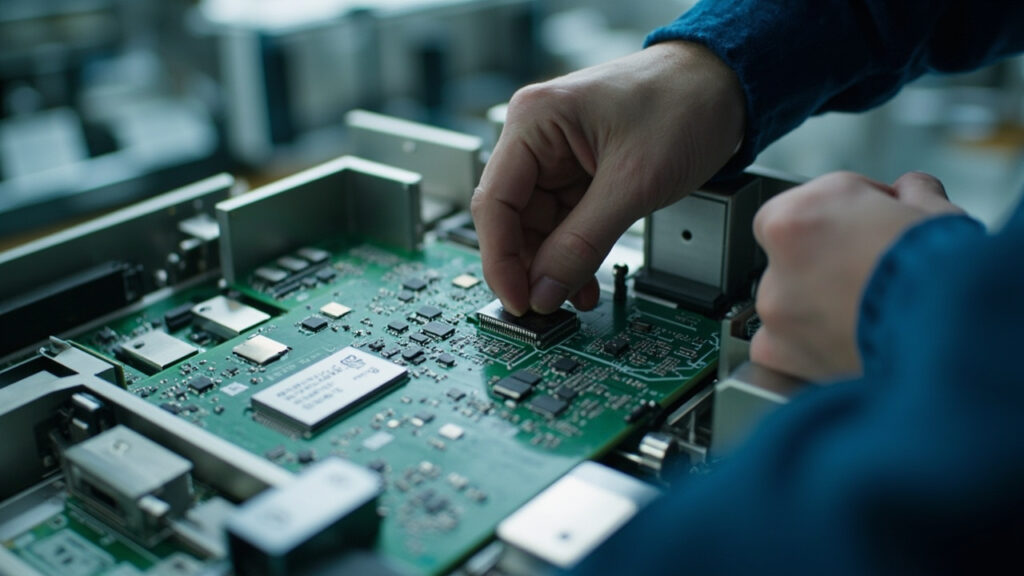
- PCB Assembly (PCBA): Full capabilities for surface mount technology (SMT) component population, including fine-pitch and BGA devices, as well as through-hole assembly.
- Surface Mount Technology (SMT): High-speed, high-precision placement of components on PCBs, ensuring correct orientation and solder joint integrity.
- Through-Hole Assembly: Manual and automated insertion of components for specific applications requiring higher power or mechanical strength.
- Testing and Inspection: Comprehensive testing protocols including Automated Optical Inspection (AOI), In-Circuit Test (ICT), functional testing, and environmental testing to ensure electronic reliability.
Value-Added Services for Comprehensive Support
Beyond core manufacturing, an integrated partner provides critical advisory and logistical support:
- Design-for-Manufacturability (DFM) Consultation: Expert guidance during the design phase to optimize products for efficient and cost-effective production, considering both mechanical and electronic aspects.
- Rapid Prototyping: Agile capabilities to quickly produce functional prototypes for design validation and iterative development.
- Blanket Order Inventory Programs: Strategic inventory management solutions to ensure production continuity and mitigate supply chain fluctuations for long-term projects.
- End-to-End Support: From initial concept review through full-scale production and post-production support, offering a complete partnership.
Selecting the Right Integrated Manufacturing Partner
When evaluating potential partners for your complex electromechanical products, consider the following:
- Breadth and Depth of Capabilities: Verify that the manufacturer truly excels in both mechanical and electronics domains, not just one.
- Experience with Complex Assemblies: Look for a track record of successfully producing products similar in complexity to yours.
- Quality Management Systems: Inquire about their quality certifications and internal processes for ensuring consistent quality across all manufacturing stages.
- Engineering and DFM Expertise: Assess their ability to provide valuable input during your design phase to optimize for manufacturability.
- Supply Chain Management: Understand their strategies for component sourcing, inventory management, and risk mitigation.
- Customer References and Case Studies: Review their portfolio and speak with existing clients to gauge their reliability and performance.
Frequently Asked Questions
What are the main benefits of using a single manufacturer for both mechanical and electronics components?
Using a single integrated manufacturer simplifies your supply chain, reduces lead times by eliminating inter-vendor shipping, and enhances product quality through coordinated design and quality control. It also provides single-point accountability for your entire assembly, streamlining communication and problem resolution.
How does integrated manufacturing improve product quality for complex electromechanical devices?
Integrated manufacturing improves quality by ensuring precise coordination of mechanical and electrical tolerances, applying consistent quality standards across all production stages, and facilitating early design-for-manufacturability (DFM) reviews. This proactive approach minimizes errors and ensures optimal fit, function, and reliability of the final product.
Can an integrated manufacturer help with design optimization?
Yes, a key advantage of an integrated manufacturer is their ability to offer design-for-manufacturability (DFM) consultation. Their combined mechanical and electrical engineering expertise allows them to identify potential production challenges early in the design phase, suggesting modifications that can improve manufacturability, reduce costs, and enhance product performance.
What kind of products benefit most from an integrated manufacturing approach?
Products that benefit most are complex electromechanical assemblies requiring tight tolerances, precise component integration, and high reliability. This includes industrial control systems, medical devices, advanced robotics, specialized computing hardware, and other sophisticated equipment where the interplay between mechanical and electronic systems is critical.
How does an integrated approach impact supply chain risks?
An integrated approach significantly reduces supply chain risks by consolidating vendor management, leveraging a single partner's procurement capabilities, and enabling more proactive risk mitigation strategies. This leads to greater stability, better material availability, and reduced exposure to disruptions compared to managing multiple specialized suppliers.
Your Partner for Integrated Electromechanical Manufacturing
For OEMs and hardware companies seeking a genuinely integrated approach to manufacturing complex electromechanical products, Four Points Platinum offers comprehensive solutions. Our facility combines precision CNC machining, sheet metal fabrication, and full PCB assembly capabilities under one roof, providing single-point accountability from rapid prototyping to full-scale production. We partner with you to ensure production continuity, supply chain security, and the highest quality for your critical assemblies.