Blog
Integrated Manufacturing Partners for Product Development: From CAD to Assembly
For original equipment manufacturers (OEMs) and hardware companies, bringing a complex product from concept to market requires more than just individual component suppliers. The ideal manufacturing partner offers a holistic approach, integrating design, mechanical fabrication, electronics assembly, and final product integration under one roof. This single-source capability streamlines the product development lifecycle, reduces coordination overhead, and ensures consistent quality and fit across all components.
This guide explores what to look for in a manufacturing partner that can collaborate effectively with your product team from initial CAD designs through prototyping, precision machining, electronics integration, and final assembly. We will detail the critical capabilities that ensure production continuity, supply chain security, and ultimately, a superior end product.
The Value of an Integrated Manufacturing Partner
Working with a single, integrated manufacturer for your product development and production offers significant advantages over managing multiple vendors. This approach minimizes communication gaps, reduces lead times, and enhances overall product quality and reliability.
Streamlined Product Development Workflow
An integrated partner can take your product from concept to completion with a unified process. This means:
- Design for Manufacturability (DFM) Collaboration: Early engagement allows for critical DFM feedback on CAD models, optimizing designs for cost-effective production, material selection, and assembly efficiency. This proactive approach can prevent costly redesigns later in the process.
- Coordinated Prototyping: Mechanical and electronic prototypes can be developed concurrently, ensuring fit, form, and function are validated together, rather than in isolation.
- Single Point of Accountability: With one partner responsible for all stages, accountability is clear, simplifying project management and issue resolution.
Enhanced Quality and Consistency
When mechanical and electronic components are manufactured and assembled by the same entity, consistency is inherently improved:
- Tight Tolerance Management: Coordinated manufacturing processes ensure that mechanical components (e.g., enclosures, brackets) precisely fit electronic assemblies (e.g., PCBs, connectors), minimizing assembly issues and improving product reliability.
- Unified Quality Control: A single quality management system oversees all stages, from raw material inspection to final product testing, ensuring consistent adherence to specifications.
- Reduced Risk of Interface Issues: Potential incompatibilities between mechanical and electronic elements are identified and resolved early in the process, preventing costly rework or field failures.
Supply Chain Simplification and Security
Consolidating manufacturing with one partner significantly de-risks your supply chain:
- Fewer Vendors to Manage: Reduces administrative burden and simplifies procurement processes.
- Optimized Inventory Management: Integrated partners can offer blanket order programs and just-in-time (JIT) delivery, reducing your inventory holding costs and ensuring material availability.
- Improved Responsiveness: A single partner can react more quickly to design changes, demand fluctuations, or supply chain disruptions.
Key Capabilities of an Ideal Integrated Manufacturing Partner
To effectively support your product team from CAD to assembly, a manufacturer must possess a comprehensive suite of capabilities. Look for partners that demonstrate expertise across these critical areas:
1. Design Collaboration and Engineering Support
- CAD/CAM Proficiency: Ability to work with various CAD file formats (e.g., SolidWorks, AutoCAD, STEP, IGES) and translate designs into manufacturing instructions.
- Design for Manufacturability (DFM) Expertise: Providing actionable feedback on designs to optimize for material selection, cost, assembly, and performance. This includes advising on tolerances, material properties, and potential manufacturing limitations.
- Prototyping Services: Rapid prototyping capabilities for both mechanical components (e.g., CNC machining, 3D printing) and electronic assemblies (e.g., quick-turn PCB fabrication and assembly) to validate designs quickly.
2. Precision Mechanical Manufacturing
- CNC Machining: Advanced multi-axis CNC milling and turning capabilities for producing complex, high-precision parts from various materials (e.g., aluminum, stainless steel, plastics). Look for tight tolerance capabilities to ensure critical fits.
- Sheet Metal Fabrication: Expertise in precision sheet metal bending, forming, cutting, and welding for enclosures, brackets, and structural components. This includes material selection for durability and environmental resistance.
- Tooling and Fixture Design/Fabrication: In-house capabilities to design and produce custom tooling and fixtures for consistent part production and efficient assembly.
3. Advanced Electronics Manufacturing
- PCB Assembly (PCBA): Surface Mount Technology (SMT) and Through-Hole Technology (THT) capabilities for populating printed circuit boards. This includes fine-pitch component placement and BGA rework.
- Automated Optical Inspection (AOI) and X-ray Inspection: Robust quality control processes for verifying solder joint integrity and component placement.
- Functional Testing: Ability to perform in-circuit testing (ICT) and functional testing (FCT) to ensure electronic assemblies meet performance specifications.
- Component Sourcing: Expertise in managing electronic component procurement, including navigating supply chain challenges and identifying alternative components when necessary.
4. Integrated Assembly and Box-Build Services
- Mechanical Assembly: Expertise in assembling complex mechanical sub-assemblies and final products, including fastening, bonding, and integration of various components.
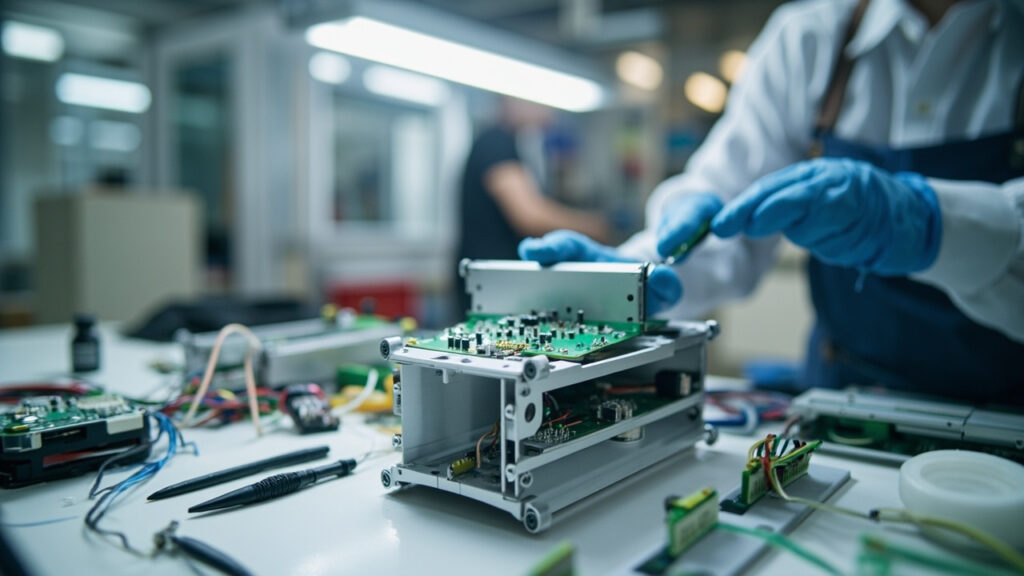
- Electro-Mechanical Assembly: Seamless integration of electronic sub-assemblies into mechanical enclosures, including wiring, cabling, and connector installation.
- Full Box-Build Assembly: Complete product assembly, including installation of all internal components, final enclosure assembly, labeling, packaging, and testing.
- Testing and Validation: Comprehensive testing protocols, including functional testing, burn-in testing, and environmental testing, to ensure the final product meets all performance and reliability requirements.
Partnering for Production Continuity and Supply Chain Security
Beyond core manufacturing capabilities, consider a partner's approach to long-term collaboration and risk mitigation. For OEMs, production continuity and supply chain resilience are paramount.
- Blanket Order Programs: Look for manufacturers offering blanket orders, allowing you to secure pricing and capacity for a defined period while releasing products as needed. This helps manage inventory and ensures consistent supply.
- Inventory Management: Partners that offer vendor-managed inventory (VMI) or consignment programs can further optimize your supply chain, reducing lead times and carrying costs.
- Scalability: Ensure the manufacturer has the capacity and processes to scale production from prototyping and low-volume runs to high-volume manufacturing as your product matures.
- Communication and Transparency: A strong partner will maintain open lines of communication, providing regular updates on production status, potential challenges, and proposed solutions.
Frequently Asked Questions
What kind of manufacturing partner can help with both mechanical and electronic product development?
A manufacturing partner specializing in integrated mechanical and electronics contract manufacturing (EMS) is ideal. These firms offer services like CNC machining, sheet metal fabrication, PCB assembly, and full box-build assembly under one roof, providing a single point of contact for complex product development.
How does an integrated manufacturer help with product design and prototyping?
An integrated manufacturer typically offers Design for Manufacturability (DFM) consultation, working with your CAD files to optimize designs for cost-effective production. They can also provide rapid prototyping services for both mechanical and electronic components, allowing for quick validation of form, fit, and function.
What are the benefits of using one company for machining, electronics, and assembly?
Consolidating these processes with a single partner streamlines communication, reduces lead times, and improves overall product quality. It ensures coordinated tolerances between mechanical and electronic components, simplifies quality control, and provides a single point of accountability for the entire assembly.
Can an integrated manufacturer help manage my product's supply chain?
Yes, many integrated manufacturers offer supply chain solutions such as blanket order programs, inventory management services, and strategic component sourcing. This helps ensure production continuity, mitigates supply chain risks, and can reduce your inventory holding costs.
What types of products benefit most from an integrated manufacturing approach?
Products with complex electro-mechanical designs, tight integration requirements between hardware and electronics, and those requiring high precision and reliability benefit significantly. This includes industrial equipment, medical devices, defense components, and advanced consumer electronics.
Your Next Step Towards Integrated Manufacturing Excellence
Selecting the right manufacturing partner is a critical decision for the success of your product. By choosing a company with comprehensive capabilities in CAD collaboration, prototyping, precision mechanical fabrication, advanced electronics assembly, and integrated box-build services, you can ensure a smoother development cycle, higher quality products, and a more resilient supply chain.
Evaluate potential partners based on their technical expertise, quality systems, communication practices, and ability to scale with your needs. A truly integrated partner becomes an extension of your product team, dedicated to bringing your innovations to life efficiently and reliably.