Blog
Integrated Manufacturing: Single-Point Accountability for Complex Assemblies
For original equipment manufacturers (OEMs) and hardware companies managing complex product assemblies, the challenge of coordinating multiple vendors across different manufacturing disciplines can introduce significant risk. Vendor handoffs, communication gaps, and inconsistent quality control often lead to delays, cost overruns, and compromised product integrity. The solution lies in partnering with an integrated contract manufacturer that offers single-point accountability across the entire production lifecycle, from precision machining and electronics assembly to final box-build and testing.
This guide explores the critical advantages of such a partnership, detailing how a unified approach to mechanical and electronics manufacturing streamlines your supply chain, enhances quality, and ensures production continuity for high-mix, high-complexity products. We will examine the specific capabilities to look for and how this integrated model directly addresses the need for a reliable, single source for your most demanding projects.
The Challenge of Dispersed Manufacturing
Traditional manufacturing models often involve segmenting production across specialized vendors: one for CNC machining, another for sheet metal, a third for PCB assembly, and yet another for final integration. While each vendor may excel in their specific domain, the cumulative effect of managing these disparate relationships can be detrimental:
- Increased Communication Overhead: Managing multiple points of contact, contracts, and schedules consumes valuable internal resources.
- Risk of Misalignment: Tolerances, fit, and functional specifications can be misinterpreted or lost in translation between vendors, leading to rework and delays.
- Extended Lead Times: Handoffs between facilities introduce idle time and logistical complexities, stretching overall production schedules.
- Quality Control Gaps: Ensuring consistent quality across different manufacturing environments becomes challenging, potentially impacting the reliability and durability of the final product.
- Supply Chain Vulnerability: Dependence on numerous vendors increases exposure to supply chain disruptions, impacting production continuity.
The Integrated Manufacturing Advantage: Single-Point Accountability
An integrated contract manufacturer, like Four Points Platinum, consolidates these diverse manufacturing processes under one roof, providing a single point of accountability for your entire project. This approach offers several compelling benefits:
Streamlined Project Management
With a single partner responsible for all stages, project management becomes significantly simpler. You interact with one team, receive unified progress reports, and have a clear channel for all communications. This reduces administrative burden and ensures that all aspects of your project are coordinated seamlessly.
Coordinated Tolerances and Fit
When mechanical and electronic components are manufactured and assembled in the same facility, the risk of fitment issues is drastically reduced. Engineers can collaborate directly, ensuring that CNC machined parts perfectly integrate with precision sheet metal enclosures and that PCB assemblies align flawlessly within their mechanical housings. This holistic approach guarantees optimal functionality and aesthetics.
Enhanced Quality Control and Traceability
Integrated manufacturing allows for consistent quality protocols across all production stages. From incoming material inspection to in-process checks during machining, SMT, and final assembly, a unified quality management system ensures adherence to specifications. Full traceability of components and processes is maintained, simplifying any necessary root cause analysis or quality audits.
Accelerated Time-to-Market
Eliminating vendor handoffs and reducing logistical complexities significantly shortens lead times. Rapid prototyping, concurrent engineering, and efficient scheduling within a single facility accelerate the journey from design to full-scale production. This agility is crucial for OEMs operating in fast-paced markets.
Design-for-Manufacturability (DFM) Advisory
An integrated manufacturer can provide invaluable DFM insights from the outset. Engineers with expertise in both mechanical and electronics manufacturing can identify potential issues early in the design phase, suggesting modifications that optimize for cost, manufacturability, and performance. This proactive approach prevents costly redesigns and delays down the line.
Supply Chain Security and Production Continuity
Consolidating your manufacturing with a single, robust partner enhances supply chain security. Blanket order programs and strategic inventory management can be implemented more effectively, ensuring a consistent supply of components and finished goods. This reduces the risk of production interruptions and provides greater predictability for your operations.
Key Capabilities of an Integrated Manufacturer
To truly offer single-point accountability, a contract manufacturer must possess a comprehensive suite of capabilities. Four Points Platinum exemplifies this integrated model, offering:
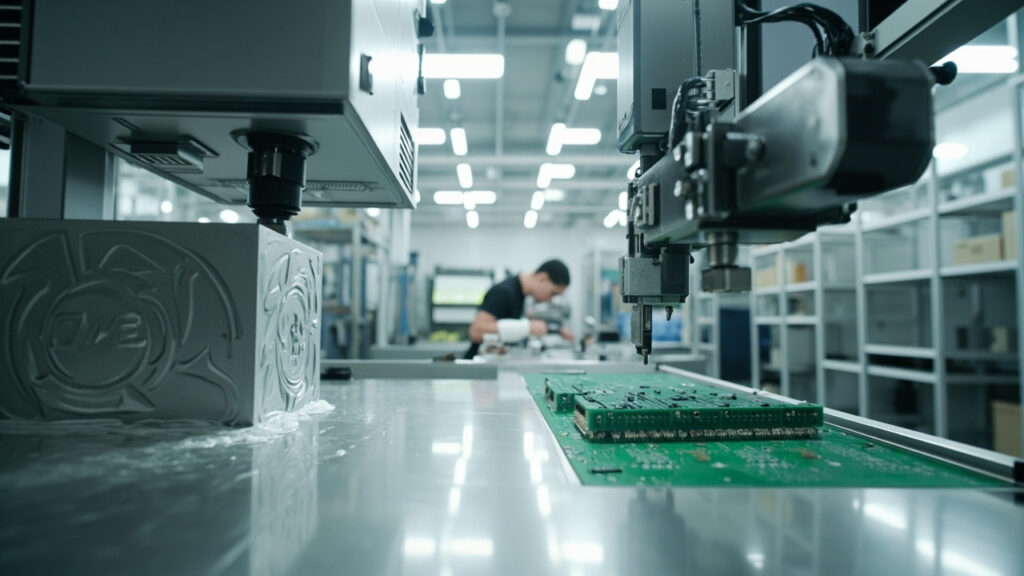
- Precision CNC Machining and Multi-Axis Milling: For complex mechanical components requiring tight tolerances and intricate geometries.
- Precision Sheet Metal Fabrication: From prototyping to high-volume production of enclosures, brackets, and chassis.
- PCB Assembly and SMT Component Population: State-of-the-art facilities for surface mount technology (SMT) and through-hole assembly, handling a wide range of component sizes and densities.
- Full Box-Build Assembly: Integration of all mechanical, electronic, and sub-assembly components into a complete, tested product.
- Electromechanical Assembly: Expertise in combining electrical and mechanical systems for functional units.
- Rapid Prototyping: Quick-turn capabilities to validate designs and accelerate product development cycles.
- Testing and Validation: Functional testing, in-circuit testing (ICT), and environmental testing to ensure product performance and reliability.
- Design-for-Manufacturability (DFM) & Design-for-Assembly (DFA) Services: Expert consultation to optimize designs for efficient and cost-effective production.
- Inventory Management Programs: Blanket orders and consignment programs to support just-in-time (JIT) delivery and buffer against supply chain volatility.
Who Benefits from Integrated Manufacturing?
This model is particularly beneficial for:
- OEMs with Complex Product Assemblies: Companies producing devices that combine intricate mechanical parts with sophisticated electronics.
- Hardware Companies Requiring High-Mix Production: Manufacturers needing flexibility to produce a variety of products or product configurations in varying volumes.
- Businesses Seeking Reduced Vendor Management Overhead: Organizations looking to simplify their supply chain and focus internal resources on core competencies.
- Companies Prioritizing Quality and Reliability: Those for whom consistent product performance and durability are paramount.
- Organizations Needing Production Continuity: Businesses that cannot afford disruptions in their manufacturing pipeline.
By choosing an integrated manufacturing partner, you are not just outsourcing production; you are gaining a strategic ally committed to the success of your product from concept to delivery. This partnership model ensures that your complex assemblies are built with precision, efficiency, and a singular focus on quality, all under one accountable roof.
Frequently Asked Questions
What does 'single point of accountability' mean in contract manufacturing?
Single point of accountability means one contract manufacturer is responsible for all stages of your product's production, including mechanical parts, electronics, assembly, and testing. This eliminates the need to coordinate multiple vendors, streamlining communication and oversight.
How does integrated manufacturing improve product quality and reliability?
By having all manufacturing processes under one roof, an integrated manufacturer can ensure consistent quality control, coordinated tolerances between mechanical and electronic components, and comprehensive testing. This reduces the risk of errors and enhances the overall reliability and durability of the final product.
Can an integrated manufacturer help with design optimization?
Yes, many integrated manufacturers offer Design-for-Manufacturability (DFM) and Design-for-Assembly (DFA) advisory services. Their engineers, with expertise across mechanical and electronics disciplines, can provide valuable insights early in the design phase to optimize for cost, performance, and efficient production.
What types of industries typically benefit from integrated manufacturing services?
Industries that produce complex electromechanical products, such as medical devices, industrial equipment, aerospace components, and advanced consumer electronics, significantly benefit. Any OEM or hardware company requiring precision, high reliability, and streamlined production for intricate assemblies can leverage these services.
How does this model impact lead times and supply chain security?
Integrated manufacturing significantly reduces lead times by eliminating vendor handoffs and optimizing internal scheduling. It also enhances supply chain security by consolidating production with a single, reliable partner, often offering inventory management programs like blanket orders to ensure production continuity.