

Blog
Achieving Single-Source Accountability in Integrated Manufacturing
For OEMs and hardware companies managing complex product assemblies, the challenge of coordinating multiple vendors for mechanical and electronic components can introduce significant operational overhead, increase risk, and complicate quality assurance. The pursuit of a single-source partner capable of delivering comprehensive manufacturing services while maintaining stringent quality controls across both mechanical and electronic domains is not just a convenience—it's a strategic imperative for production continuity, supply-chain security, and ultimately, product integrity.
This guide explores the critical advantages of engaging a single-source integrated manufacturing partner, detailing how such a collaboration can streamline your production process, enhance quality oversight, and simplify project management for even the most intricate assemblies. We will delve into the specific capabilities that define a truly integrated manufacturer and how their approach to quality control ensures consistent performance from concept to final product.
The Complexity of Multi-Vendor Management in Integrated Assemblies
Modern electronic products often require a seamless integration of precision mechanical components with sophisticated electronic systems. This typically involves separate suppliers for CNC machined parts, sheet metal enclosures, PCBs, and final assembly. Each vendor brings its own processes, quality standards, lead times, and communication channels. The resulting fragmentation can lead to:
- Coordination Challenges: Managing schedules, deliveries, and specifications across multiple entities. Discrepancies in component tolerances can lead to fitment issues during final assembly, causing rework and delays.
- Quality Control Gaps: Inconsistencies in quality standards between mechanical and electronic suppliers can result in suboptimal performance or outright failure of the integrated product. Identifying the root cause of a defect becomes significantly more complex when multiple parties are involved.
- Increased Risk: Supply chain disruptions affecting one vendor can cascade through the entire production line. Lack of visibility into each supplier's operations can hinder proactive problem-solving.
- Higher Total Cost of Ownership: Beyond unit costs, the administrative burden, potential for rework, and extended lead times associated with multi-vendor management contribute to a higher overall project cost.
- Accountability Ambiguity: When an issue arises in a complex assembly, determining which vendor is responsible for the defect can be a protracted and costly process, delaying resolution and impacting time-to-market.
The Single-Source Advantage: Unifying Mechanical and Electronic Manufacturing
A truly integrated contract manufacturer, such as Four Points Platinum, offers a compelling solution to these challenges by consolidating the entire production process under one roof. This approach provides a unified point of accountability and a cohesive quality management system across all manufacturing disciplines.
Integrated Capabilities for Comprehensive Solutions
An effective single-source partner will possess a broad spectrum of in-house capabilities, enabling them to manage every stage of your product's journey. This includes:
- Precision Mechanical Manufacturing:
- CNC Machining and Multi-Axis Milling: For high-precision components requiring tight tolerances, complex geometries, and superior surface finishes. This includes capabilities for various metals and engineering plastics.
- Precision Sheet Metal Fabrication: For enclosures, chassis, brackets, and structural components, ensuring accurate forming, bending, and welding.
- Mechanical Assembly and Box Builds: Integration of machined and fabricated parts into subassemblies or complete product enclosures, including hardware installation and functional testing.
- Fixtures and Tooling: In-house design and production of custom fixtures to ensure repeatable accuracy and efficiency throughout the manufacturing process.
- Advanced Electronics Manufacturing (EMS):
- PCB Assembly (PCBA): Surface Mount Technology (SMT) component population for high-density, high-performance boards, alongside through-hole assembly for robust connections and larger components.
- Automated Optical Inspection (AOI): For rapid and accurate detection of defects in solder joints, component placement, and polarity on PCBs.
- Functional Testing: Comprehensive testing of electronic assemblies to verify performance against design specifications.
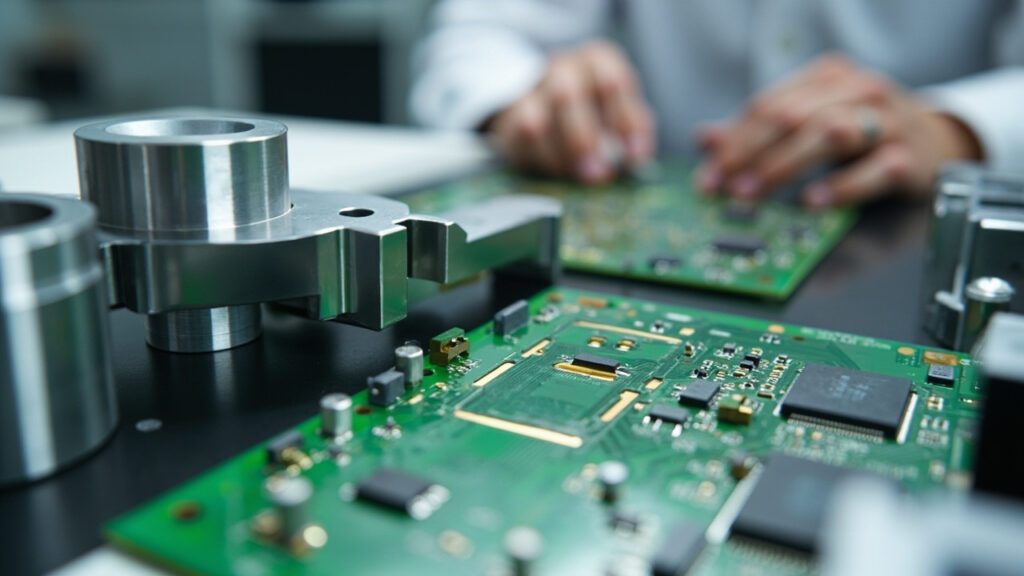
- Integrated Assembly and Box Build: The critical phase where mechanical and electronic components converge. A single-source provider manages this integration, ensuring perfect fit, form, and function. This includes cable harness assembly, final enclosure integration, and comprehensive system-level testing.
How Single-Source Accountability Enhances Quality Control
With all manufacturing processes under one management system, quality control becomes inherently more robust and transparent. Key aspects include:
- Unified Quality Management System: A single set of quality protocols, documentation, and inspection procedures applied across both mechanical and electronic production lines. This eliminates discrepancies and ensures consistent adherence to specifications.
- Coordinated Tolerances and Fit: Design and manufacturing teams work collaboratively from the outset, ensuring that mechanical and electronic components are designed and produced to integrate seamlessly. This proactive approach minimizes fitment issues and rework during final assembly.
- Design-for-Manufacturability (DFM) Advisory: Expert DFM consultation at the design phase helps optimize components for both mechanical and electronic production, reducing potential manufacturing challenges, improving yield, and lowering overall costs. This includes considerations for material selection, assembly sequence, and testability.
- Single Point of Contact and Responsibility: All communication, project management, and issue resolution are channeled through one entity. This simplifies oversight for the OEM, accelerates problem-solving, and ensures clear accountability for the entire product's quality and delivery.
- End-to-End Traceability: A single system allows for comprehensive tracking of components, processes, and quality checks from raw material to finished product, providing unparalleled visibility and facilitating rapid root-cause analysis if an issue arises.
- Reduced Lead Times and Improved Uptime: Streamlined communication and integrated scheduling minimize delays between production stages, leading to faster time-to-market and more predictable delivery schedules. This also contributes to higher uptime for production lines by reducing the likelihood of component-related stoppages.
Practical Applications and Benefits for OEMs
Consider an OEM developing a new industrial control unit. This unit requires a precisely machined aluminum enclosure, custom sheet metal brackets, and a complex multi-layer PCB with SMT components. Engaging a single-source partner means:
- Simplified Procurement: Instead of managing separate POs, contracts, and relationships with a machine shop, a sheet metal fabricator, and a PCBA house, the OEM deals with one vendor.
- Enhanced Design Collaboration: The mechanical and electrical engineering teams at the manufacturing partner can collaborate directly on DFM, ensuring the enclosure design accommodates PCB mounting points, thermal management, and connector access perfectly.
- Consistent Quality: The same quality engineers oversee both the machining of the enclosure and the assembly of the PCB, ensuring that all components meet the required specifications and integrate flawlessly.
- Faster Prototyping and Iteration: Changes to either mechanical or electronic aspects can be implemented and tested more quickly within a single facility, accelerating the development cycle.
- Supply Chain Security: Blanket order inventory programs offered by integrated manufacturers provide a buffer against supply chain volatility, ensuring components are available when needed.
This integrated approach is particularly valuable for national brands and OEMs that demand high reliability and consistent quality for their products, where even minor discrepancies can have significant operational or reputational consequences. The ability to achieve coordinated tolerances and fit across diverse manufacturing disciplines is a hallmark of a mature integrated partner.
Partnering with Four Points Platinum
Four Points Platinum exemplifies the capabilities of an integrated mechanical and electronics contract manufacturer. Based in the Austin metro area, we offer a comprehensive suite of services designed to provide single-source accountability for complex assemblies. Our expertise spans from rapid prototyping to full-scale production, serving OEMs that require precision, reliability, and a streamlined manufacturing process. Our experience with demanding clients like Dell, IBM, and 3M underscores our commitment to quality and operational excellence.
By consolidating your mechanical and electronic manufacturing needs with a single partner, you gain not only efficiency but also a strategic advantage in bringing high-quality, integrated products to market with confidence and control.
Frequently Asked Questions
What does 'single-source accountability' mean in manufacturing?
Single-source accountability means that one manufacturing partner is responsible for the entire production process of a complex assembly, encompassing both mechanical and electronic components. This simplifies project management, streamlines communication, and ensures a single point of contact for all quality and delivery concerns.
How does an integrated manufacturer ensure quality across different disciplines like CNC machining and PCB assembly?
An integrated manufacturer employs a unified quality management system that applies consistent standards and inspection protocols across all manufacturing processes, from CNC machining and sheet metal fabrication to PCB assembly and final box builds. This ensures coordinated tolerances, fit, and functional performance of the complete assembly.
Can a single-source partner help with design optimization for both mechanical and electronic parts?
Yes, a key benefit of an integrated single-source partner is their ability to provide Design-for-Manufacturability (DFM) advisory services that consider both mechanical and electronic aspects simultaneously. This helps optimize designs for efficient production, reduce potential issues, and improve overall product quality and cost-effectiveness.
What types of products benefit most from integrated mechanical and electronics manufacturing?
Products that require precise integration of mechanical components (like enclosures, chassis, or custom brackets) with complex electronic systems (such as PCBs with SMT components) benefit most. This includes industrial controls, medical devices, telecommunications equipment, and other high-tech hardware where fit, function, and reliability are critical.
How does this approach impact lead times and supply chain security?
By consolidating manufacturing operations, an integrated single-source partner can significantly reduce lead times by eliminating transfer delays between vendors and optimizing production schedules. They can also enhance supply chain security through blanket-order inventory programs and better visibility into the entire production flow.
What level of assembly can an integrated manufacturer typically handle?
An integrated manufacturer can handle a wide range of assembly levels, from sub-assemblies of mechanical or electronic components to full box-builds. This includes integrating PCBs into custom enclosures, wiring harnesses, and performing comprehensive system-level functional testing to deliver a complete, ready-to-deploy product.