Blog
Integrated Electromechanical Manufacturing: One Partner for Mechanical and Electronics
For OEMs and hardware companies needing their first production run, integrated electromechanical manufacturing provides a single source for both mechanical and electronic assemblies. This approach simplifies the supply chain by consolidating multiple vendors into one, ensuring coordinated production and accountability.
Four Points Platinum, based in Pflugerville, Texas, offers this integrated capability, handling everything from CNC machining to PCB assembly under one roof.
Key Takeaways
- Integrated electromechanical manufacturing combines mechanical and electronics production with a single supplier, reducing hand-offs and streamlining the supply chain.
- This approach offers benefits like coordinated tolerances, single-point accountability, and improved design-for-manufacturability feedback for complex assemblies.
- Working with one integrated partner from rapid prototyping through full-scale production can ensure continuity and supply-chain security for OEMs.
- A single quote for complete assemblies simplifies procurement and provides a clear cost structure for complex electromechanical products.
- Integrated manufacturers can provide blanket order programs and inventory readiness, crucial for maintaining production continuity and managing demand fluctuations.
The complexity of modern hardware demands precise coordination between mechanical and electronic components. When launching a new product or scaling up an existing one, managing separate suppliers for mechanical parts and electronic assemblies can introduce significant challenges. Integrated electromechanical manufacturing addresses these issues by offering a unified approach to production.
Why is Integrated Electromechanical Manufacturing Important for Production Runs?
Integrated electromechanical manufacturing combines the production of mechanical components and electronic assemblies within a single facility. This consolidation is critical for ensuring that all parts of a complex product fit and function together precisely. By eliminating the need for multiple vendors, OEMs can reduce logistical overhead, minimize communication errors, and accelerate time to market.
This unified approach is particularly beneficial for products requiring tight tolerances and intricate interfaces between mechanical and electronic systems. A single manufacturer overseeing both aspects can proactively identify and resolve potential fitment or performance issues early in the production cycle. This contrasts sharply with managing separate machine shops and EMS providers, where coordination often falls to the OEM, increasing risk and complexity.
What are the Challenges of Using Separate Suppliers for Mechanical and Electronics?
Managing separate suppliers for mechanical parts and electronic assemblies introduces several points of failure and inefficiency. Each hand-off between vendors creates an opportunity for miscommunication, delays, and discrepancies in specifications. This can lead to costly rework, extended lead times, and ultimately, a compromised final product.
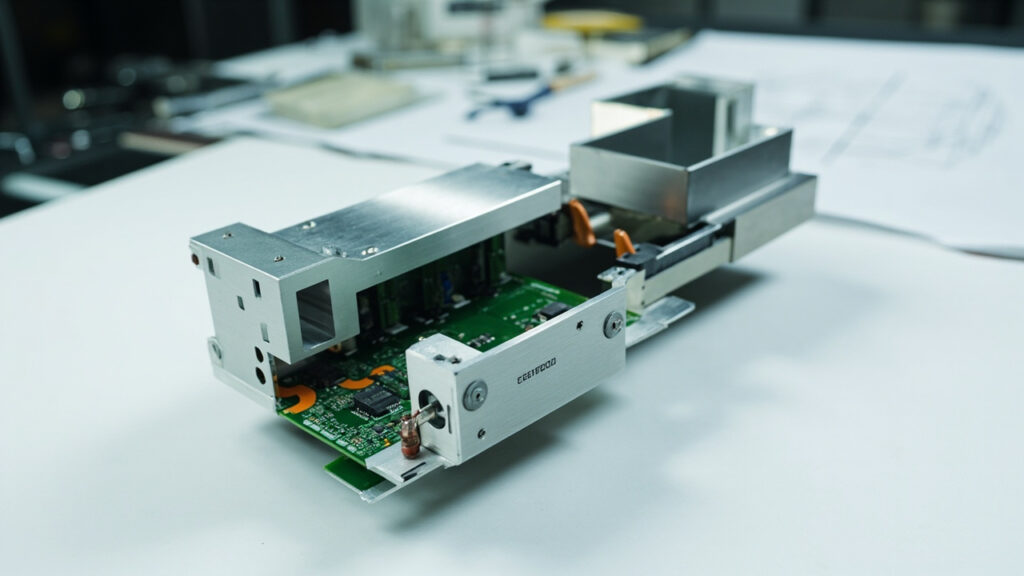
Consider the coordination required for a complex box-build assembly. If the mechanical enclosure is produced by one supplier and the populated printed circuit board (PCB) by another, the OEM must act as the intermediary, ensuring that the dimensions, mounting points, and interface requirements are perfectly aligned. This burden increases with product complexity and production volume, often leading to a fragmented supply chain.
| Feature | Integrated Manufacturer | Separate Machine Shop & EMS Provider |
|---|---|---|
| Accountability | Single point of contact for the complete assembly | Multiple points of contact, OEM manages coordination |
| Hand-offs | Internal, streamlined | External, requiring OEM management and logistics |
| Lead Time | Potentially shorter due to internal coordination | Often longer due to external scheduling and logistics |
| Design Feedback | Coordinated DFM across mechanical and electronics | Separate DFM feedback, potential conflicts |
| Quality Control | Unified inspection and testing protocols | Disparate quality processes, requiring OEM oversight |
| Cost Structure | Single quote for complete assembly, transparent | Multiple quotes, complex cost aggregation |
| Risk Management | Centralized, easier to track and mitigate | Decentralized, higher risk of blame-shifting |
How Does Integrated Manufacturing Improve Design-for-Manufacturability (DFM)?
Design-for-Manufacturability (DFM) is significantly enhanced when mechanical and electronics manufacturing are integrated. With both capabilities under one roof, engineers can collaborate directly on design optimizations that consider the entire product. This holistic perspective allows for simultaneous evaluation of mechanical fit, electronic performance, and assembly processes.
For example, during the design phase, an integrated team can assess how a specific enclosure design might impact thermal management for electronic components, or how a PCB layout could simplify mechanical assembly. This cross-functional insight helps identify potential manufacturing challenges early, leading to more robust designs, reduced material waste, and lower production costs. NIST Manufacturing Extension Partnership (MEP) emphasizes that DFM is crucial for reducing costs and improving product quality by addressing manufacturing considerations during the design phase.
Four Points Platinum provides design-for-manufacturability advisory, ensuring that designs are optimized for efficient and repeatable production. This proactive engagement helps OEMs move from prototype to production with greater confidence and fewer revisions.
What Services Does an Integrated Electromechanical Manufacturer Offer?
An integrated electromechanical manufacturer offers a comprehensive suite of services that span both mechanical and electronic production. This typically includes everything from initial prototyping to full-scale production, ensuring continuity throughout the product lifecycle. The goal is to provide a single source for all manufacturing needs, simplifying the procurement process for OEMs.
Key services include:
- CNC Machining: Precision machining of metal and plastic components, including multi-axis milling for complex geometries.
- Precision Sheet Metal Fabrication: Forming, bending, and welding of sheet metal parts for enclosures, brackets, and chassis.
- PCB Assembly (SMT and Through-Hole): Populating printed circuit boards with surface mount technology (SMT) components and through-hole devices.
- Fixtures and Subassemblies: Manufacturing custom fixtures for assembly and testing, as well as building complex subassemblies.
- Box-Build Assembly: Complete product assembly, including integrating mechanical parts, electronic components, wiring, and final testing.
- Rapid Prototyping: Quickly producing functional prototypes to validate designs and test functionality before mass production.
- Design-for-Manufacturability (DFM) Consultation: Expert feedback to optimize designs for efficient and cost-effective manufacturing.
- Blanket Order and Inventory Programs: Managing inventory and providing scheduled deliveries to ensure production continuity and supply-chain security.
Four Points Platinum offers these integrated services, covering end-to-end support from rapid prototyping to full-scale production. This includes coordinated tolerances and fit, along with single-point accountability for complete assemblies.
How Does Integrated Manufacturing Support Prototype to Production Scaling?
Scaling from prototype to production is a critical phase for any new product, and integrated manufacturing significantly streamlines this transition. When the same partner handles both prototyping and production, the knowledge gained during the initial stages is directly applied to the manufacturing process, minimizing learning curves and potential issues. This continuity is vital for maintaining product integrity and accelerating market entry.
The transition from low-volume prototype runs to repeatable production requires robust processes and consistent quality control. An integrated manufacturer with documented workflows for quoting, scheduling, inspection, and change control can ensure that each stage of production is managed effectively. This systematic approach helps maintain quality and consistency as production volumes increase.
For OEMs, having a single partner manage this entire journey means fewer hand-offs and a more predictable path to market. This approach is particularly valuable for high-mix, low-to-medium volume production, where flexibility and rapid iteration are often required. Four Points Platinum supports this transition, offering product development from prototype to production with a single partner, as detailed in their insights on [Product Development: Prototype to Production with a Single Partner](/insights/blog/seamless-product-development-prototype-to-production-with-a-single-partner).
What are the Benefits of a Single Quote for Complete Assemblies?
Obtaining a single quote for a complete electromechanical assembly simplifies the procurement process and provides a clear, consolidated view of costs. Instead of managing multiple quotes from different suppliers for mechanical parts, electronic components, and assembly services, OEMs receive one comprehensive proposal. This reduces administrative burden and eliminates the complexity of reconciling disparate pricing structures.
A single quote also fosters greater transparency regarding the total cost of ownership. It allows OEMs to evaluate the overall value proposition more effectively, considering not just individual component costs but also the efficiencies gained from integrated manufacturing. This approach can reveal hidden costs associated with managing multiple vendors, such as increased shipping, inventory holding, and quality control overhead.
Furthermore, a consolidated quote from an integrated manufacturer often reflects optimized production processes. The manufacturer can leverage internal efficiencies and coordinated workflows to offer a competitive price for the entire assembly, rather than pricing individual services in isolation. This streamlined financial management is a significant advantage for budgeting and cost control.
How Do Blanket Orders and Inventory Programs Enhance Supply Chain Security?
Blanket orders and inventory readiness programs are crucial for maintaining production continuity and enhancing supply chain security, especially in volatile market conditions. An integrated manufacturer can offer these programs, allowing OEMs to secure production capacity and material availability without committing to immediate, large-volume purchases. This flexibility is invaluable for managing demand fluctuations and mitigating supply chain risks.
Under a blanket order, an OEM commits to purchasing a certain quantity of assemblies over a specified period, with scheduled deliveries. The manufacturer then holds the necessary inventory of raw materials and finished components, ensuring that products are available when needed. This reduces lead times and protects against material shortages or price increases. SME highlights that effective inventory management is a cornerstone of lean manufacturing, reducing waste and improving responsiveness.
For OEMs and hardware companies that need production continuity and supply-chain security, these programs provide peace of mind. Four Points Platinum offers blanket-order inventory programs, ensuring that critical components and assemblies are ready for production as required. This proactive approach to inventory management minimizes disruptions and supports consistent product delivery. Their insights on [High-Mix, Low-to-Medium Volume Production for OEMs](/insights/blog/high-mix-low-to-medium-volume-production-for-oems) further detail their capabilities in this area.
What Should Be Included in an RFQ for a Complete Electromechanical Assembly?
When requesting a quote for a complete electromechanical assembly, a comprehensive Request for Quotation (RFQ) is essential to ensure that all requirements are clearly communicated and understood. A well-structured RFQ helps the integrated manufacturer provide an accurate and competitive proposal, minimizing ambiguities and potential rework.
Key elements to include in an RFQ for a complete assembly:
- Detailed Bill of Materials (BOM): List all components, including mechanical parts, electronic components, fasteners, and consumables, with part numbers, manufacturers, and quantities.
- Mechanical Drawings: Provide CAD files (e.g., STEP, SolidWorks) and 2D drawings with dimensions, tolerances, material specifications, and surface finishes for all mechanical parts.
- Electronic Schematics and PCB Layout Files: Include Gerber files, drill files, assembly drawings, and netlists for all PCBs. Specify component placement and orientation.
- Assembly Instructions: Detailed step-by-step instructions for the complete box-build assembly, including torque specifications, wiring diagrams, and special handling requirements.
- Test Procedures: Outline functional test requirements, environmental testing, and any specific quality control checks. Include pass/fail criteria.
- Packaging and Shipping Requirements: Specify packaging materials, labeling, and shipping instructions, including any special handling for sensitive components.
- Production Volume and Schedule: Indicate initial prototype quantities, anticipated low-volume production runs, and projected full-scale production volumes and timelines.
- Quality Standards: Mention any required industry standards (e.g., IPC-A-610 for electronics assembly, ISO 9001 for quality management systems) or customer-specific quality requirements.
- Design-for-Manufacturability (DFM) Expectations: State whether DFM feedback is expected and at what stage of the project.
Providing a thorough RFQ enables the integrated manufacturer to accurately assess the project scope and provide a precise quote, leading to a smoother production process.
How Do Integrated Manufacturers Ensure Quality and Reliability?
Ensuring quality and reliability in complex electromechanical assemblies requires robust processes and a commitment to continuous improvement. Integrated manufacturers achieve this through a combination of documented workflows, skilled personnel, and advanced inspection and testing methodologies. The unified nature of integrated production allows for a more cohesive quality management system across both mechanical and electronic domains.
Quality control begins with incoming material inspection, verifying that all raw materials and components meet specified requirements. Throughout the manufacturing process, in-process inspections are conducted at critical stages, such as after CNC machining, during sheet metal fabrication, and after PCB assembly. This proactive approach helps identify and correct defects early, preventing them from propagating to later stages.
For electronics, standards like IPC-A-610 provide guidelines for the acceptability of electronic assemblies, ensuring consistent quality. For mechanical components, precise measurement tools and techniques are used to verify dimensional accuracy and adherence to tolerances. Final assembly undergoes comprehensive functional testing to ensure the complete product performs as intended. Documented workflows for quoting, scheduling, inspection, and change control are fundamental to maintaining consistent quality and reliability.
Frequently Asked Questions
What is integrated electromechanical manufacturing?
Integrated electromechanical manufacturing is a production approach where a single supplier handles both the mechanical and electronic manufacturing of a product. This includes services like CNC machining, sheet metal fabrication, PCB assembly, and full box-build assembly, providing a unified solution from prototype to production.
Why choose an integrated manufacturer over separate suppliers?
Choosing an integrated manufacturer reduces complexity, minimizes hand-offs, and improves accountability. It ensures coordinated tolerances and fit between mechanical and electronic components, streamlines communication, and often results in faster lead times and better design-for-manufacturability feedback. This consolidated approach simplifies project management for OEMs.
Can an integrated manufacturer help with product design?
Yes, many integrated manufacturers offer design-for-manufacturability (DFM) advisory services. They provide expert feedback during the design phase to optimize the product for efficient and cost-effective production, considering both mechanical and electronic aspects simultaneously. This collaboration helps prevent manufacturing issues before they arise.
What types of products benefit most from integrated manufacturing?
Products with complex interactions between mechanical and electronic systems, such as industrial control units, medical devices, aerospace components, and consumer electronics, benefit significantly. Any product requiring tight tolerances and precise integration of diverse components is a strong candidate for this manufacturing model.
How does integrated manufacturing impact lead times?
Integrated manufacturing can often reduce overall lead times by eliminating the delays associated with coordinating multiple external suppliers. Internal hand-offs are more efficient, and a single point of accountability streamlines the entire production schedule, from raw materials to finished goods. This efficiency contributes to faster market entry.
Next Step
To discuss your next production run and explore the benefits of integrated electromechanical manufacturing, contact Four Points Platinum to request a consultation.