

Blog
Single Source Contract Manufacturer for Electromechanical Assemblies
A single source contract manufacturer can build complete electromechanical subassemblies for robotics or automation equipment by integrating both mechanical and electronics manufacturing under one roof. This approach streamlines production, reduces hand-offs, and improves accountability for complex assemblies.
Such manufacturers offer services from rapid prototyping to full-scale production, ensuring coordinated tolerances and fit for critical components.
Key Takeaways
- Integrated mechanical and electronics manufacturing from a single source simplifies complex electromechanical subassembly production.
- Consolidating suppliers reduces project management overhead, minimizes hand-offs, and enhances overall supply chain security.
- Design-for-manufacturability (DFM) consultation from a single partner ensures optimal design for both mechanical and electronic components.
- A single source can provide end-to-end support, from rapid prototyping through to full production, including blanket order programs.
- Documented workflows for quoting, scheduling, inspection, and change control are critical for maintaining production continuity and quality.
The increasing complexity of robotics and automation equipment demands a manufacturing approach that can handle both precision mechanical components and intricate electronic assemblies effectively. Traditional methods often involve managing multiple suppliers, leading to potential communication gaps, extended lead times, and accountability challenges. A single source contract manufacturer addresses these issues by offering a unified solution for electromechanical subassemblies.
Why is a single source beneficial for complex electromechanical assemblies?
Integrating mechanical and electronics manufacturing under one roof offers significant advantages for complex electromechanical assemblies. When separate suppliers handle mechanical and electronic components, coordination becomes a major challenge, often leading to delays and errors at the integration stage. A single source provider manages the entire process, from initial design consultation through final assembly, ensuring consistent quality and fit. This unified approach is particularly valuable for applications in robotics and automation, where precision and reliability are paramount.
The benefits extend beyond mere convenience. A single point of contact simplifies communication and problem-solving, as all aspects of the project are managed by one team. This reduces the administrative burden on OEMs and hardware companies, allowing their internal teams to focus on core competencies rather than supplier management. Furthermore, a single source can offer design-for-manufacturability (DFM) feedback that considers both mechanical and electronic aspects simultaneously, optimizing the design for efficient and cost-effective production.
What services does an integrated contract manufacturer provide?
An integrated contract manufacturer offers a comprehensive suite of services that span both mechanical and electronics manufacturing. For mechanical components, this typically includes CNC machining for precision parts, multi-axis milling, and precision sheet metal fabrication. These capabilities ensure that housings, brackets, and other structural elements meet exact specifications. The mechanical services also encompass fixture design, subassembly, and full box-build assembly, providing a complete solution for physical integration.
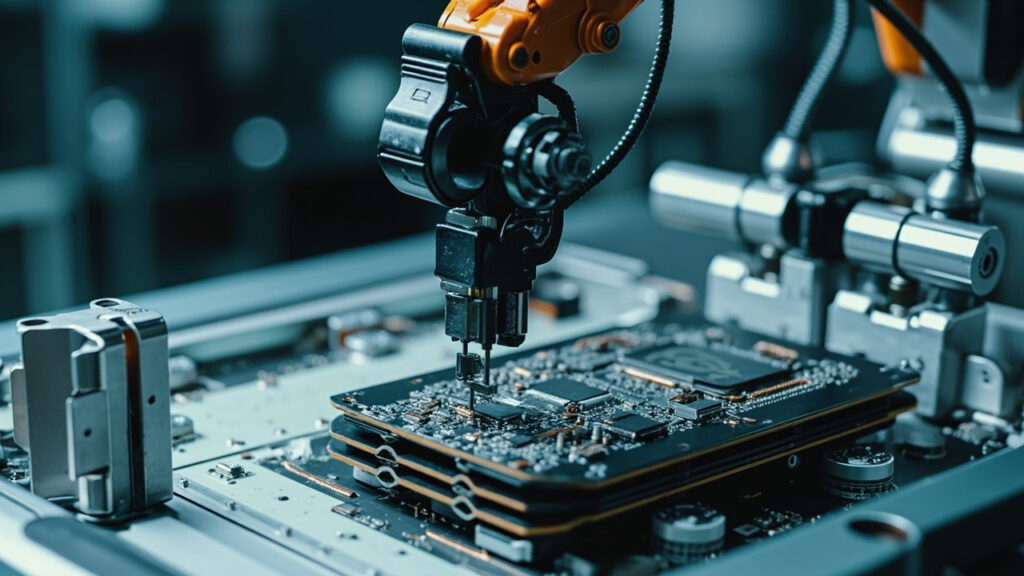
On the electronics side, services include PCB assembly, surface mount technology (SMT) component population, and through-hole assembly. These capabilities are essential for producing the control boards, sensor arrays, and power management systems that drive robotics and automation equipment. By offering both sets of services, the manufacturer can manage the entire bill of materials (BOM) and ensure that all components, whether mechanical or electronic, are manufactured to coordinate precisely. Four Points Platinum, for example, offers both mechanical manufacturing—CNC machining, fabrication, assembly and box builds, fixtures, and subassemblies—and electronics manufacturing—PCB assembly, surface mount technology (SMT), and through-hole assembly.
How does a single supplier streamline the production process?
Streamlining the production process for electromechanical assemblies involves minimizing hand-offs and consolidating accountability. When an OEM works with separate mechanical and electronics manufacturers, each transfer of components introduces potential delays, quality control issues, and communication breakdowns. A single source contract manufacturer eliminates these hand-offs by performing all critical operations internally. This means that mechanical parts are designed and manufactured with the electronic components in mind from the outset, and vice versa.
This integrated approach leads to shorter lead times and a more predictable production schedule. For instance, design changes can be implemented across both mechanical and electronic aspects simultaneously, preventing costly rework or redesigns downstream. Documented workflows for quoting, scheduling, inspection, and change control further enhance efficiency and transparency. This unified control over the entire manufacturing process ensures that the final electromechanical subassembly meets all performance and quality requirements.
| Aspect | Separate Machine Shop & EMS Provider | Single Source Contract Manufacturer |
|---|---|---|
| Quotes | Two or more separate quotes | One comprehensive quote |
| Project Management | Multiple points of contact | Single point of contact |
| Hand-offs | Frequent transfers between suppliers | Internal, controlled transfers |
| Lead Time | Often extended due to coordination | Reduced and more predictable |
| Accountability | Divided responsibilities | Single point of accountability |
| DFM Feedback | Potentially conflicting or limited | Integrated mechanical and electronic |
| Quality Control | Separate inspection processes | Unified quality assurance |
| Supply Chain Risk | Higher due to multiple dependencies | Lower due to consolidated control |
What role does Design-for-Manufacturability (DFM) play in integrated manufacturing?
Design-for-Manufacturability (DFM) is a critical component of integrated manufacturing, especially for complex electromechanical assemblies. DFM involves optimizing a product's design to facilitate efficient and cost-effective manufacturing, while maintaining its functional requirements. In a single source environment, DFM consultation considers both the mechanical and electronic aspects of an assembly concurrently. This holistic approach helps identify potential manufacturing challenges early in the design phase, preventing costly revisions later.
For example, a DFM review might suggest minor adjustments to a PCB layout to accommodate specific mechanical clearances, or recommend a different material for a housing to improve thermal dissipation for electronic components. This integrated feedback ensures that the final design is not only functional but also optimized for production efficiency, material usage, and assembly ease. Such proactive engagement can significantly reduce overall project costs and accelerate time to market. NIST Manufacturing Extension Partnership emphasizes the importance of DFM in improving product quality and reducing manufacturing costs.
How do blanket orders and inventory programs enhance supply chain security?
For OEMs and hardware companies, maintaining production continuity and supply-chain security is paramount. Blanket order programs and inventory readiness initiatives offered by a single source contract manufacturer are crucial tools for achieving this. A blanket order allows a buyer to commit to purchasing a certain quantity of components or assemblies over a specified period, without needing to place individual purchase orders for each delivery. This provides the manufacturer with predictable demand, enabling them to optimize their production schedule and secure raw materials in advance.
In turn, the manufacturer can hold finished goods or critical components in inventory, ready for immediate shipment as needed. This "just-in-time" or "just-in-case" inventory strategy minimizes the risk of stockouts and production delays for the OEM, even in the face of unexpected demand spikes or supply chain disruptions. This level of inventory readiness is particularly valuable for high-mix, low-to-medium volume production, where flexibility and responsiveness are key. Four Points Platinum offers blanket-order inventory programs for OEMs and hardware companies that need production continuity and supply-chain security.
What are the considerations for moving from prototype to production?
The transition from prototype to full-scale production is a critical phase for any new product, especially for electromechanical assemblies. A single source contract manufacturer can provide end-to-end support, from rapid prototyping to repeatable production, ensuring a smooth and efficient scale-up. Rapid prototyping allows for quick iteration and validation of designs, both mechanically and electronically, before committing to larger production runs. This iterative process helps identify and resolve design flaws early, reducing the risk of costly changes later.
Once the prototype is validated, the manufacturer leverages established processes and quality controls to transition to low-volume and then full-scale production. This includes detailed process documentation, rigorous inspection protocols, and robust change control procedures. The goal is to ensure that every unit produced meets the exact specifications and quality standards established during the prototyping phase. This effective transition is vital for maintaining product integrity and market competitiveness.
For more on this, consider the insights on [Product Development: Prototype to Production with a Single Partner](/insights/blog/seamless-product-development-prototype-to-production-with-a-single-partner).
What quality standards and certifications are relevant for electromechanical assembly?
Quality standards and certifications are fundamental to ensuring the reliability and performance of electromechanical assemblies. While specific certifications vary by industry and application, several are broadly relevant. For electronics manufacturing, standards such as those published by IPC, like IPC-A-610 for acceptability of electronic assemblies, are widely recognized. These standards provide guidelines for workmanship and quality control in PCB assembly and component population.
For mechanical manufacturing and overall quality management, ISO 9001 is a globally recognized standard that specifies requirements for a quality management system (QMS). Adherence to ISO 9001 demonstrates a company's commitment to consistent quality and continuous improvement. Depending on the end application, other certifications like ITAR (International Traffic in Arms Regulations) for defense-related products, or specific industry standards for medical devices or automotive components, may also be required. OEMs should always inquire about a manufacturer's relevant certifications to ensure compliance and quality assurance.
How does a unified approach impact total cost of ownership?
A unified approach to electromechanical assembly manufacturing can significantly impact the total cost of ownership (TCO) for OEMs. While the initial per-unit cost might seem comparable to using multiple suppliers, the hidden costs associated with managing multiple vendors often add up. These include increased administrative overhead for supplier management, longer lead times leading to delayed market entry, and higher risks of quality issues requiring rework or warranty claims.
By consolidating with a single source, OEMs reduce these indirect costs. The streamlined communication, integrated DFM, and unified quality control processes minimize errors and accelerate production. Furthermore, blanket order programs and inventory management reduce the financial burden of holding excess inventory or facing production stoppages due to component shortages. Over the product's lifecycle, these efficiencies translate into a lower TCO, making the single source model a more economically viable option for complex electromechanical assemblies.
For more information on optimizing production, refer to [High-Mix, Low-to-Medium Volume Production for OEMs](/insights/blog/high-mix-low-to-medium-volume-production-for-oems).
What to include in an RFQ for a complete assembly?
When requesting a quote for a complete electromechanical assembly, providing comprehensive information is crucial for receiving accurate and competitive bids. An effective Request for Quote (RFQ) should clearly outline both the mechanical and electronic requirements. Key elements to include are:
- Complete Bill of Materials (BOM): List all components, including part numbers, manufacturers, quantities, and any approved alternatives.
- Detailed Mechanical Drawings: Provide CAD files, 2D drawings with dimensions, tolerances, material specifications, and surface finishes for all mechanical parts.
- PCB Design Files: Include Gerber files, drill files, assembly drawings, and any specific fabrication notes for electronic boards.
- Assembly Instructions: Step-by-step guides for how components are to be integrated, including torque specifications, wiring diagrams, and testing procedures.
- Testing Requirements: Specify functional tests, environmental tests, and quality control checks that the final assembly must pass.
- Volume and Schedule: Indicate anticipated production volumes (prototype, low-volume, high-volume) and desired delivery timelines.
- Packaging and Shipping Instructions: Detail any specific requirements for packaging, labeling, and logistics.
- Quality Standards and Certifications: List any required industry standards (e.g., IPC, ISO) or regulatory compliance needs.
Providing this level of detail enables the single source contract manufacturer to provide a precise quote and identify any potential DFM issues early on.
Frequently Asked Questions
What is an electromechanical subassembly?
An electromechanical subassembly combines both mechanical and electronic components into a single, functional unit. These units are designed to perform specific tasks within a larger system, such as a robotic arm's gripper mechanism or an automation system's control module, integrating power, sensing, and motion.
How does a single source manufacturer improve product quality?
A single source manufacturer improves product quality by maintaining unified control over both mechanical and electronic production processes. This integrated approach ensures coordinated tolerances, consistent material quality, and comprehensive quality checks across all components, reducing the risk of interface issues and assembly errors.
Can a single source handle both prototyping and full production?
Yes, a key advantage of a single source contract manufacturer is their ability to support projects from rapid prototyping through to full-scale production. This continuity ensures that design lessons learned during prototyping are effectively integrated into the production process, optimizing efficiency and consistency.
What are the benefits of blanket orders for OEMs?
Blanket orders offer OEMs several benefits, including enhanced supply chain security, predictable pricing, and reduced administrative overhead. They allow manufacturers to plan production and secure materials in advance, ensuring product availability and mitigating risks associated with supply chain volatility and demand fluctuations.
How does integrated manufacturing reduce lead times?
Integrated manufacturing reduces lead times by eliminating the need for multiple hand-offs between separate mechanical and electronic suppliers. All processes, from design review to final assembly, occur under one roof, streamlining communication, accelerating problem-solving, and optimizing the overall production schedule.
Next Step
To explore how an integrated mechanical and electronics contract manufacturer can support your next electromechanical assembly project, request a consultation to discuss your specific requirements and project scope.